
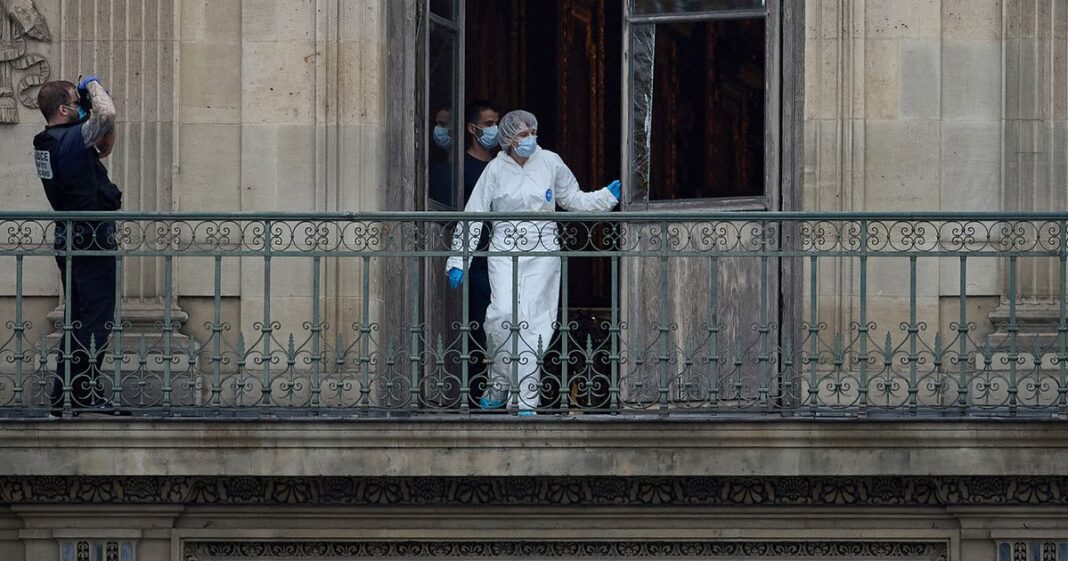

Two individuals have been apprehended in connection with the recent theft of eight valuable crown jewels from the Louvre Museum in France. One of the suspects was captured at Paris Charles de Gaulle Airport while trying to board a flight to Algeria days after the robbery, where a gang pilfered £76 million worth of jewelry. Authorities had been monitoring the suspects following forensic evidence linking them to the vicinity of the Louvre on the day of the heist.
In standard procedure following a theft, law enforcement hoped that the suspects would lead them to the stolen items. However, upon spotting one of the suspects at the airport, detectives swiftly made the decision to arrest them. The individuals were taken to the secure premises of the Paris judicial police for questioning.
During the robbery, the Louvre was placed on lockdown after the gang, disguised in high-visibility vests, used a mechanical ladder on a truck to access a first-floor balcony. They then broke into the Galerie d’Apollon through a window using power tools before fleeing on scooters. The stolen jewelry included a brooch adorned with 2348 diamonds and a tiara featuring 1083 diamonds, both once worn by Napoléon Bonaparte’s relatives.
As they made their escape, the thieves dropped a lavish headpiece crafted for Empress Eugénie, Napoléon III’s wife, at the 1855 Universal Exhibition in Paris, sustaining significant damage that will necessitate extensive restoration efforts.
President Emmanuel Macron vowed to apprehend the culprits and recover the stolen items, prompting a wide-ranging search for the thieves. The recent arrests come after investigators disclosed the discovery of over 150 DNA traces, including fingerprints, left behind by the burglars. Paris prosecutor Laure Beccuau expressed optimism that the forensic analysis of these samples would swiftly lead to the identification of the four perpetrators.
Beccuau emphasized the importance of quick apprehension to prevent the removal of the jewelry’s stones or the melting of the metals. The Louvre, a top global tourist destination, attracts millions of visitors annually, with a majority being tourists, including a substantial number from the UK. Perpetrators stealing historic artworks often operate under the instructions of dealers who struggle to sell the items on the black market.
The Louvre has a history of security breaches, notably in 1911 when the Mona Lisa was stolen by an employee and remained missing for two years before being recovered and secured behind bulletproof glass. In 1998, a 19th-century painting by Camille Corot was stolen and never found, leading to significant enhancements in museum security measures.