
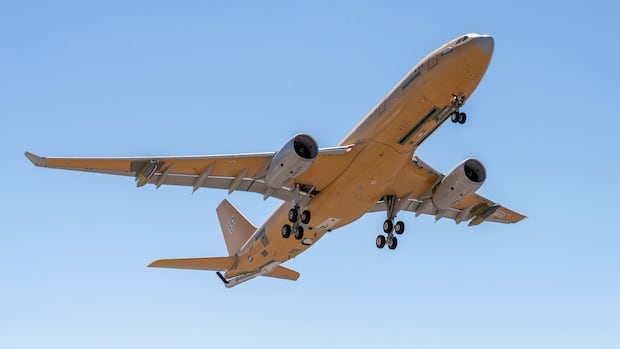

Canada’s air force will not receive the first of four new air tankers crucial for refueling fighter jets in the Arctic until the end of next year. The Royal Canadian Air Force (RCAF) has provided details on the state of the CC-330 Husky fleet, which is replacing its aging Airbus 310s. These wide-body jets are essential for the air force’s intercontinental operations, including transporting troops and the prime minister globally. However, their primary function as aerial refueling stations is vital for Canada’s continental defense strategy.
A spokesperson for the Department of National Defence informed CBC News that the initial new aircraft will be handed over to the RCAF by late 2027. In a $3.6 billion deal in July 2023, Canada acquired nine Airbus A330s, comprising five lightly used jets from Kuwait Airways and four brand-new planes. The specific number of aircraft to be delivered by next year had not been previously disclosed.
Currently, three of the pre-owned Airbus planes have arrived, operating in their original passenger configuration. While one is undergoing scheduled maintenance at Mirabel Airport, another is being revamped in Switzerland with new interior and defense components. The fifth aircraft is in Spain for conversion into an air tanker. The first newly manufactured tanker is undergoing testing in Spain, with the remaining three under production in Toulouse, France.
The RCAF’s fleet of CF-18s and upcoming F-35s rely on air tankers to maintain Arctic patrol duties. These fighter jets consume fuel rapidly and often collaborate with air tankers to extend their operational range. The importance of air tankers was underscored during the FIFA World Cup events in Toronto. The new tankers will feature the necessary equipment to refuel all NATO-compatible aircraft, addressing the shortcomings of the aircraft they are replacing.
Additionally, the air force confirms that the new V-VIP Airbus, currently undergoing refurbishment in Switzerland for the prime minister’s use, will be equipped with a “self-protection suite” to guard against missile threats. This suite may include a combination of lasers, flares, and decoy measures. While most components of this system will be discreet, noticeable modifications on the aircraft’s exterior will hint at its enhanced defensive capabilities.
The air force anticipates achieving initial operational capability for the CC-330 Husky fleet by 2028-29, with full operational readiness for all nine jets by 2032-33. While the current jets are stationed in Ottawa, new facilities are under construction in Trenton, Ontario, and Edmonton.
The RCAF’s fleet of five older Airbus A310s, known as the CC-150 Polaris, which were originally Wardair passenger planes from the late 1980s, will remain in service until 2030. One of the A310s was written off following a mishap in Guam in 2023, where it collided with a French cargo plane due to issues with parking brakes and safety procedures. Despite this incident, the remaining three aircraft will continue operations for the next decade.