
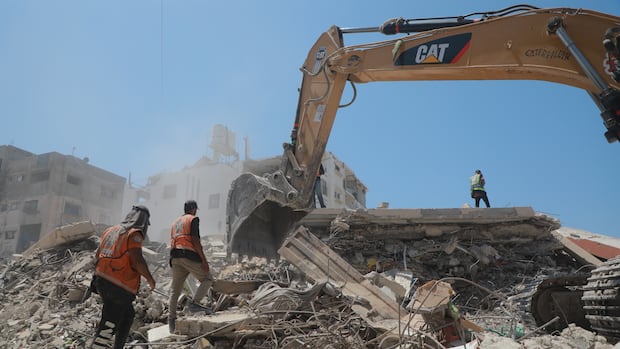

In Gaza City, members of the Al-Drimli family are diligently searching through the debris of their former residence to locate the remains of a friend and neighbor. Armed with basic tools like shovels, buckets, and a wheelbarrow, they toil under the scorching sun, with the clattering of shovels and the whirring of an electric saw providing the soundtrack to their somber task.
Having already found the bodies of their loved ones, the Al-Drimli family is now focused on locating their neighbor, who was present in the building when it was struck by an airstrike in November 2023. The Gaza Health Ministry estimates that around 8,000 to 10,000 bodies are still trapped under the rubble nearly three years after the conflict between Israel and Hamas began.
Due to the scarcity of excavators in Gaza, many Palestinians, like the Al-Drimli family, are compelled to rely on manual labor to sift through the wreckage in search of their deceased relatives. Ayman Al-Drimli highlighted the challenges they face in acquiring expensive and scarce equipment for this grim task.
With only a handful of operational excavators in Gaza, Samir Sabra, along with his son Uday Sabra, operate two of them in the region. However, the exorbitant cost of running the machinery poses a significant hurdle, with the price of oil alone being a prohibitive factor. Their efforts are further hampered by the severe shortage of maintenance resources and spare parts.
The relentless demand for their services is overwhelming, as Uday Sabra and his father struggle to keep up with the requests for their excavators. The severe shortage of equipment compounds the challenges of clearing the vast amounts of rubble and debris left behind by the conflict.
Mahmoud Basal, spokesperson for the Palestinian Civil Defence, attributes the scarcity of excavators in Gaza to deliberate targeting during the conflict. Despite the ceasefire agreement last October, which aimed to facilitate the entry of heavy machinery for clearance operations, little progress has been made on the ground.
Restrictions imposed by Israeli authorities on essential supplies like fuel, oil, and spare parts have exacerbated the situation, impeding the maintenance and operation of critical equipment in Gaza. Calls from humanitarian organizations and Civil Defence for international intervention to expedite the entry of machinery into the region have so far yielded limited results.
Amidst the challenging circumstances, Uday Sabra persists in his excavation efforts, determined to provide closure to the families of the deceased by recovering their remains from the rubble. The arduous task of clearing the debris and retrieving bodies is expected to extend over a prolonged period if the current constraints on heavy machinery persist.