
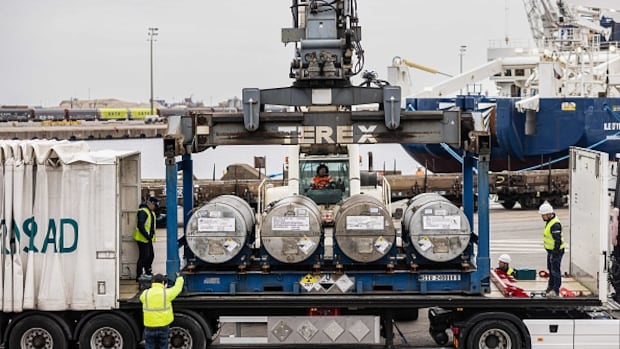

Amid the military actions by Russian President Vladimir Putin in Ukraine, which included taking control of the country’s largest nuclear plant and targeting its power infrastructure, it has been revealed that Europe and the United States rely on Russian nuclear fuel for their electricity needs.
One of the recipients of low enriched uranium (LEU) from Russia is Canadian-owned Westinghouse Electric, as per shipping data analyzed by CBC’s investigative program, the fifth estate. The U.S. had imposed a ban on Russian enriched uranium imports in August 2024 to reduce dependence on Russian materials and secure a domestic fuel supply. However, the Prohibiting Russian Uranium Imports Act allows waivers under certain conditions, with the waivers set to expire by January 1, 2028.
The U.S. imported significant amounts of low enriched uranium from Russia in 2025, with major recipients including subsidiaries of French-owned Framatome, Global Nuclear Fuel Americas, and Westinghouse. On the other hand, the European Union does not have a ban on Russian enriched uranium imports, and Canada has not imposed sanctions on dealings with Russia’s state atomic energy corporation Rosatom or its export arm, Tenex.
The fifth estate’s analysis of shipping data revealed ongoing uranium shipments from Russia to Westinghouse’s South Carolina facility, where the uranium is processed into fuel pellets for commercial nuclear power reactors. Despite efforts to reduce dependence on Russian enriched uranium, the U.S. and Europe have a long history of relying on Russian supplies, with plans to boost domestic production to reduce this reliance gradually.
Westinghouse, a significant player in the U.S. nuclear industry, has been involved in agreements with Ukraine to supply fuel and construct new reactors, aiming to replace Russia as Ukraine’s nuclear fuel source. The situation highlights the complexities of shifting away from Russian supplies while ensuring a stable energy infrastructure.