
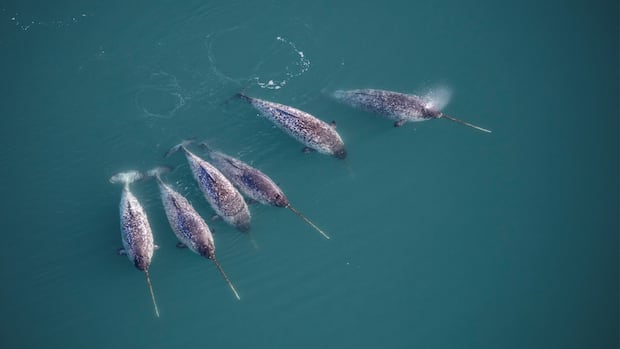

A peculiar wonder of nature, the narwhal tusk can reach lengths of up to three meters. It is a straight upper tooth emerging through the whale’s lip on the left side, making it the only mammal tusk that grows without any curves.
An international team of researchers has uncovered the reason behind its straight growth, attributing it to the unique pattern of opposing spirals. Henrik Birkedal from Aarhus University in Denmark expressed surprise at the discovery of two opposing spirals, one turning right and the other left, which contribute to the tusk’s straightness.
Recently published in the journal Nature Communications, new research delves into how these opposing spirals enable the narwhal tusk to grow in a straight manner. The investigation originated when Birkedal was approached by a colleague studying molecular chirality, intrigued by the consistent leftward spiraling of narwhal tusks in Greenland.
Collaborating with biologists from Greenland and physicists from Sweden, Birkedal’s team employed advanced imaging techniques akin to CT scans to unveil the structure of the tusks and spirals. They discovered two opposing spirals – a left-handed spiral on the outer cementum layer and a right-handed one in the inner dentine layer, shedding light on the structural principles of human bones and similar cases.
Renowned narwhal biologist Martin Nweeia from Harvard University lauded the research’s in-depth analysis of what he deems “the most extraordinary tooth on the planet.” While acknowledging the speculative nature of the tusk’s function in the paper, Nweeia emphasized his research indicating that the primary role of the tusk is sensory rather than defensive or for feeding purposes.
Looking ahead, Nweeia expressed a desire for future narwhal studies to incorporate off-season research and collaboration with Indigenous communities in the Canadian Arctic, where most narwhals reside during the summer. Integrating scientific knowledge with traditional Inuit observations can provide a comprehensive understanding of these elusive creatures.