
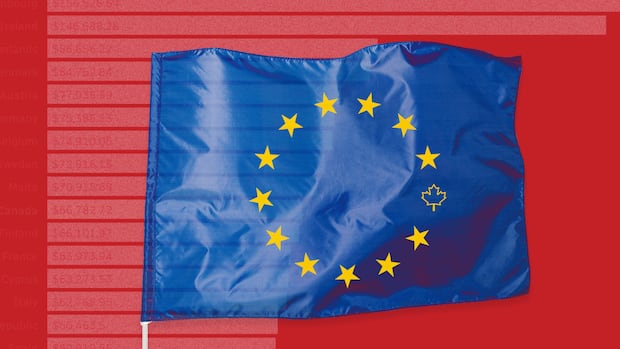

The European Union has expressed interest in Canada becoming the inaugural “associate member” of the 27-nation bloc, amid a global trend towards expanding trade partnerships beyond the United States. In her state of the union address, European Commission President Ursula von der Leyen emphasized the need for the EU and Canada to reimagine their alliance beyond a conventional free-trade agreement.
Canadian Prime Minister Mark Carney also welcomed closer relations in his address, highlighting Canada’s pursuit of resilience and sovereignty. He proposed a deeper integration across critical sectors including minerals, artificial intelligence, defense, energy, research, and finance. Carney stressed the importance of sovereignty and resilience in maintaining freedoms and withstanding challenges.
While the designation of “associate member” is not currently recognized under EU regulations, Canada is set to enhance its trade relations with Europe. Comparatively, Canada’s GDP per capita positions it in the middle of EU countries, outperforming France, Italy, and Spain but trailing behind Germany. Noteworthy non-EU nations like Australia and Iceland exhibit stronger economic performance than Canada within the OECD framework.
In terms of inflation, Canada has maintained a two percent rate in 2025, outperforming several EU counterparts. However, the EU faces challenges such as high energy prices due to geopolitical tensions. The eurozone has initiated interest rate hikes to combat inflationary pressures.
Regarding total debt-to-GDP ratio, Canada’s metrics are less favorable compared to potential EU membership criteria. The International Monetary Fund has urged Canada to prioritize reducing this ratio in fiscal planning. Carney highlighted Canada’s low net debt-to-GDP ratio within the G7, emphasizing the distinction from the total debt-to-GDP ratio.
In examining Canada’s current trade ties with the EU, imports from the EU totaled $92 billion while exports amounted to $39 billion last year. Germany plays a central role in Canada’s trade relations with the EU, with imports including machinery, vehicles, and pharmaceuticals, and exports comprising energy products, ores, and precious metals.