
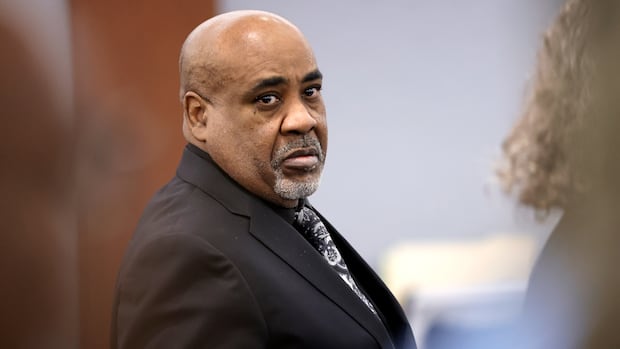

A jury has declared Duane “Keffe D” Davis guilty of masterminding the 1996 assassination of rap legend Tupac Shakur, leading to the first conviction in a case that has captivated hip-hop enthusiasts for years. The 63-year-old Davis was found guilty on Monday of murder with a deadly weapon and could face life imprisonment. Following a weeks-long trial in Las Vegas, the jury deliberated for three hours.
After the verdict was announced, Shakur’s sister, Sekyiwa “Set” Shakur, wept and reached out to someone behind her. In the courtroom, Davis’s son covered his face with one hand. Chief Deputy District Attorney Binu Palal informed the jurors during closing arguments that Davis obtained a firearm and actively pursued Shakur and Death Row Records co-founder Marion “Suge” Knight after they assaulted Davis’s nephew earlier that night. Palal acknowledged that Davis’s narratives of the incident had changed over time but argued that these discrepancies reflected Davis’s shifting motives and attempts to safeguard himself. One crucial detail, according to Palal, remained consistent: Davis consistently placed himself inside a white Cadillac from which the shots were fired.
Davis’s defense lawyer, Michael Sanft, urged the jurors to identify evidence beyond Davis’s own statements that placed him in Las Vegas or inside the Cadillac on the night of Shakur’s shooting. He highlighted the absence of surveillance footage, phone records, and other proof linking Davis to the scene.
The long-standing case has attracted attention from both hip-hop fans and crime experts. Tupac Shakur, a highly influential rapper, was in Las Vegas on September 7, 1996, when a white Cadillac pulled up next to him at a red light and shots were fired. He succumbed to his injuries six days later. Knight was also wounded but survived. For years, there were no charges in Shakur’s murder until Davis began publicly stating that he was in the Cadillac and provided the gun to others in the vehicle. Davis portrayed the shooting as an act of retribution following the assault on his nephew by Knight and Shakur’s entourage.
Under Nevada law, an individual who assists another in committing murder can be held accountable for the crime. Davis is the sole surviving person among the four men prosecutors claim were in the Cadillac. Palal informed the jurors that if they trust Davis’s statements, additional corroborating evidence is not necessary.
Palal emphasized that the shooting was premeditated, citing testimony and Davis’s accounts that the group actively sought Shakur before encountering him on the road.
During the trial, Palal referenced Davis’s 2019 memoir, “Compton Street Legend,” and an interview where Davis urged people to purchase the book for the “real truth.” Palal dismissed the defense’s argument that Davis falsified his accounts for financial gain, stating that profiting from a murder is entirely different. Prosecution rebutted by pointing to a scrapbook Davis kept with articles about Shakur, suggesting he was documenting the murder.
The prosecution didn’t claim that Davis physically pulled the trigger but contended that he was legally responsible for providing the gun and ordering the attack. Davis’s accounts of the event varied in different interviews, with inconsistencies in who actually fired the fatal shots.