
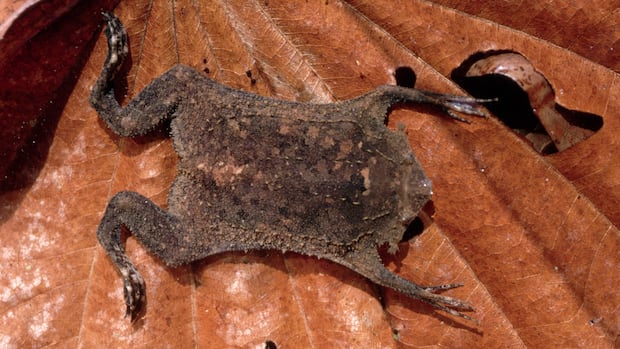

In a peculiar natural phenomenon, the Surinam toad exhibits distinctive traits, including its unconventional method of offspring delivery. Videos capturing the birthing process of this fully aquatic toad reveal fully developed young emerging through small pores on the mother’s back.
Characterized by its flat body, limited vision, and absence of a tongue, the Surinam toad, commonly found in the Amazon basin, can easily blend into its environment, resembling a lifeless leaf on the sea bed. However, recent research by California scientists has unveiled another intriguing aspect of this creature – its ability to “see” using its fingertips.
Despite its visual limitations and the murky waters it inhabits, the Surinam toad demonstrates remarkable hunting skills, swiftly capturing prey in fractions of a second. With a width of 15-20 centimeters, the toad lies in wait with outstretched forelimbs, swiftly engulfing unsuspecting fish that come too close.
A study led by Duncan Leitch and his team from the University of California, Los Angeles, revealed that the Surinam toad, also known as the star-fingered toad, utilizes its fingertips to detect subtle water movements created by nearby prey. The toad’s fingers possess highly sensitive touch organs, akin to the precision of the human eye’s fovea, enabling it to discern the size and proximity of potential meals.
By leveraging its advanced touch sensitivity, the toad can snatch prey without direct contact, even in darkness. The researchers observed that the toad’s fingertips host 128 tiny lobes, each adorned with numerous papillae that enhance touch sensitivity, akin to human fingertips.
The significance of this discovery lies in the toad’s unique brain adaptation to process sensory information from its fingertips efficiently. This adaptation, previously associated with more complex mammal brains, demonstrates a convergent evolutionary strategy between frogs and mammals, highlighting a shared solution to optimizing sensory perception.
Lea Randall, a conservation program senior manager at the Wilder Institute in Calgary, emphasized the groundbreaking nature of these findings, shedding light on how different vertebrates have evolved sophisticated sensory systems. This research offers valuable insights into the evolutionary adaptations of amphibians and their remarkable brain utilization strategies.