
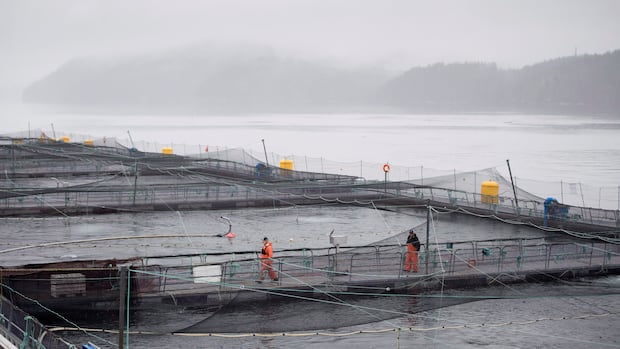

A recent study by the Pacific Salmon Foundation reveals that viral heart disease, specifically heart and skeletal muscle inflammation (HSMI), is more prevalent in open-net salmon farms in British Columbia than previously acknowledged. The research discovered HSMI in five out of seven open-net pen salmon farms located in the Broughton Archipelago, situated east of Port McNeill on Vancouver Island. The study highlights that the disease-causing virus, piscine orthoreovirus (PRV), has the potential to spread to wild fish in the surrounding waters.
Lead author Emiliano Di Cicco emphasized that the incidence of the disease is significantly higher than previously believed, contrary to earlier assumptions. The study, involving the examination of 749 salmon by three independent pathologists across the farms, found that nearly seven percent showed signs of HSMI. While the role of PRV in causing HSMI was uncertain in the past, recent experiments by Norwegian researchers in 2017 confirmed the connection.
According to the researchers, Pacific salmon infected with PRV can experience various health issues such as anemia, heart inflammation, liver and kidney damage, and jaundice. Di Cicco advocates for the reclassification of PRV as a pathogenic virus by the Department of Fisheries and Oceans (DFO) in British Columbia. He also suggests aligning the diagnostic criteria for the disease with international standards, as the current standards used by DFO may overlook cases of the chronic, low-level condition.
The DFO has stated its intention to review the study and incorporate its findings into future assessments. The department emphasized that the mere detection of a virus in farmed fish does not automatically imply negative impacts on wild salmon populations. Furthermore, the DFO defended its diagnostic criteria for HSMI, developed in collaboration with scientific experts to meet global standards.
The study was carried out in collaboration with the Mamalilikulla, ʼNa̱mǥis, and Ḵwiḵwa̱sut’inux̱w Ha̱xwa’mis First Nations. Indigenous leaders expressed their concerns about the impact of open-net pen salmon farms on salmon populations, emphasizing the vital role of salmon in supporting coastal Indigenous communities. Rick Johnson, Chief of the Kwikwasut’inuxw Haxwa’mis First Nation, and Don Svanik, elected chief councillor of the Namgis First Nation, highlighted the importance of preserving salmon populations for both ecological and cultural reasons.