
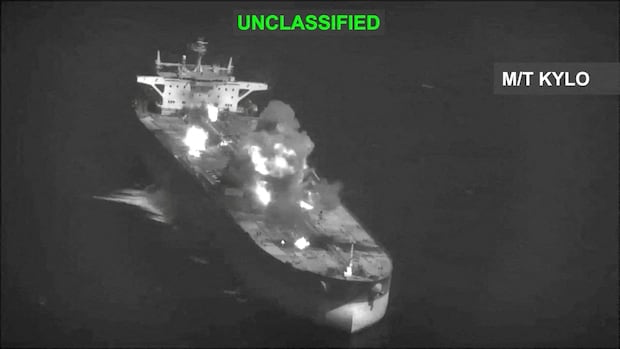

U.S. military forces have reportedly attacked three Iranian oil tankers in response to ballistic missiles targeting Navy warships, the American military confirmed on Saturday, emphasizing a readiness to eliminate Iran’s vulnerable oil fleet if required. This action is viewed as a risky escalation following Iran’s previous assaults on commercial ships at sea.
The recent strikes signal a renewed shift towards conflict after a period of intermittent confrontations since February 28, when the conflict initiated with strikes by the U.S. and Israel on Iran. Both sides have been aiming to inflict military and economic harm, leading to the breakdown of negotiations.
According to the military’s statement, a U.S. aircraft carrier and a destroyer successfully evaded multiple unprovoked Iranian attacks while patrolling the region, resulting in no injuries to U.S. personnel. The statement mentioned that two Iranian oil tankers were rendered inoperable, while the third, which was empty, was destroyed.
The U.S. military alleges that the targeted tankers were part of a clandestine network supporting Iran’s Revolutionary Guard and its allied forces in the area. In response, Iran reportedly retaliated by targeting three American vessels, as per Iran’s state broadcaster, although this has not been immediately verified.
The situation further intensified when Iran purportedly launched a ballistic missile at a U.S. aircraft carrier, indicating a heightened willingness to confront vital U.S. military assets in the region. The U.S. Central Command’s Admiral Brad Cooper emphasized the commitment to defend American forces and take necessary action against Iran’s oil fleet.
Iran’s Foreign Ministry condemned the attacks as war crimes, attributing the responsibility for any further aggression or economic warfare to Washington and its allies. As tensions rise, the exact number of Iranian oil tankers impacted by the conflict remains unclear, with reports of previous strikes on Iranian ships during the U.S. blockade of Iranian ports.
The recent hostilities resumed after a period of relative calm, with the Strait of Hormuz and Iranian territories facing renewed attacks. Tragically, at least five individuals lost their lives, including casualties from a wedding that was struck during a U.S. bombardment in southern Iran.
The resumption of conflict follows U.S. initiatives to tighten economic sanctions on Iran, while the elected Iranian government has expressed a preference for a negotiated resolution. Despite efforts to circumvent sanctions and port blockades, Iran continues to face economic challenges, relying on covert means to export its oil.
The situation underscores the ongoing struggle over Iran’s nuclear program and the strategic importance of the Strait of Hormuz, a critical passage for global oil and gas shipments. Diplomatic efforts to address Iran’s nuclear obligations have faltered, with discussions veering towards potential U.N. Security Council involvement due to compliance issues.
Amid the escalating tensions, the U.S. military remains vigilant in safeguarding maritime traffic in the strait, where Iranian control poses threats to international shipping.