
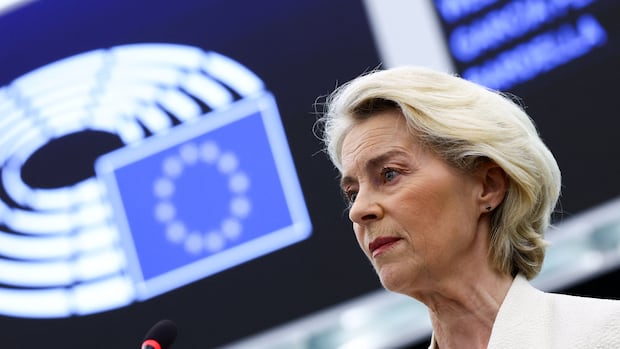

Ursula von der Leyen, President of the European Commission, stated that Europe intends to create an opportunity for Canada to become an “associate member” of the European Union.
Prime Minister Mark Carney was present in the front row as von der Leyen outlined essential elements for enhanced collaboration between Europe and Canada in Strasbourg, France.
During her address on the state of the union, she emphasized the necessity for the two to “urgently reimagine” their collaboration and to progress beyond merely a free-trade agreement.
“I would like to collaborate with you in paving the way for Canada to become the first associate member of the EU,” von der Leyen declared on Wednesday, eliciting a standing ovation.
In response, Carney nodded, stood up, approached von der Leyen, and shared an embrace with her. He briefly waved to the assembly before taking his seat again.
“We share one ocean, one set of values, one perspective on the world,” she continued. “And now we will also forge our common future together — thank you for your presence here.”
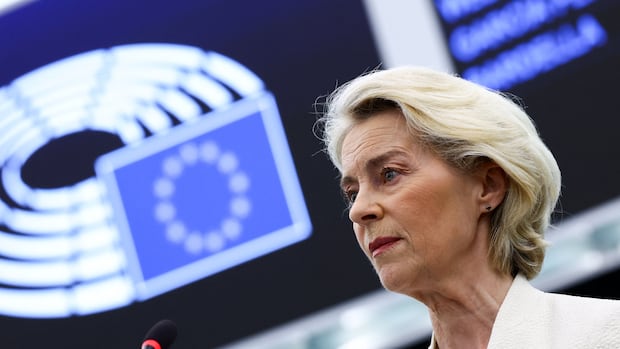
Ursula von der Leyen, President of the European Commission, emphasized the evolving global landscape in her state of the European Union address, highlighting the potential of the Canada-Europe relationship. ‘This partnership is not against anyone else, but for our collective strength.’
Carney is in France this week to strengthen ties with Europe, with a primary focus on trade, defence, and interpersonal connections.
In her speech, von der Leyen mentioned that Europe aims to elevate its relationship with Canada to the “highest level possible.”
The idea of associate membership was initially brought up last week when the Wall Street Journal, citing unnamed sources, reported that Canada was considering potential membership.
- Just Asking wants to know: What inquiries do you have regarding the EU and what “a unique alliance” with the bloc might entail for Canada? Send us your questions before our show on September 19.
Carney expressed skepticism regarding the report at the Toronto International Film Festival on Sunday, stating that Canada is not pursuing European Union membership, but is instead seeking a “unique alliance” with the economic bloc.
He is scheduled to address the European Parliament on Thursday, at the invitation of European Parliament President Roberta Metsola.
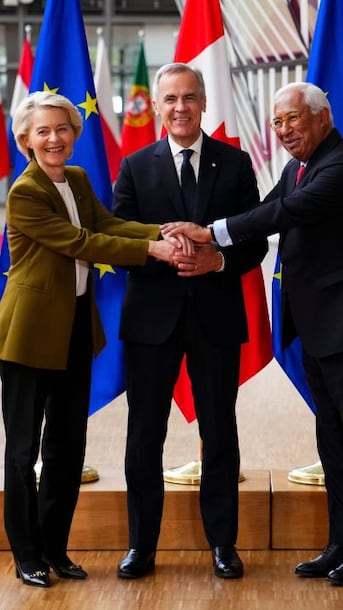
Prime Minister Mark Carney has stated that Canada is ‘not looking to be a member of the European Union.’ However, if Canada were to consider joining the EU, what are the implications? Here are the facts.
Carney was welcomed with a red-carpet reception earlier on Wednesday at the European Parliament building, where he was greeted by Metsola and von der Leyen.
He received applause upon entering the chamber and a standing ovation after Metsola formally introduced him.
“Mark, your presence here symbolizes the lasting friendship between our nations,” von der Leyen remarked during her address, which extended over an hour. “Our cultural, historical, and personal connections are deeply woven into the fabric of our societies.
“We view the world through a similar lens: from AI to climate change, from the Arctic to geopolitical matters. We have united on Ukraine, defence, raw materials, and supply chains.”
Von der Leyen stated that Europe and Canada would transition from a free trade agreement to “a partnership for the future,” while enhancing collaboration on Arctic issues, energy, critical minerals, and battery technology.
EU representative downplays ‘associate’ label
In a statement, the Prime Minister’s Office did not clarify the proposal for Canada to achieve associate membership in the EU, instead emphasizing von der Leyen’s other comments regarding partnership formation.
“We appreciate President von der Leyen’s suggestion that Canada and the European Union transition beyond the [free trade agreement] to a future-oriented alliance,” a spokesperson mentioned.
“This represents a unique and positive approach that we will define collectively.”
- Just Asking wants to know: What inquiries do you have regarding the EU and what “a unique alliance” with the bloc might entail for Canada? Send us your questions before our September 19 show.
The term “associate member” does not have a legal definition within the EU, and the rules of the bloc stipulate that only European nations can apply for membership.
Jonathan Wilkinson, Canada’s soon-to-be ambassador to the EU, downplayed von der Leyen’s suggestion, indicating that both parties are “a long way off” from agreeing on a term for their potential relationship.
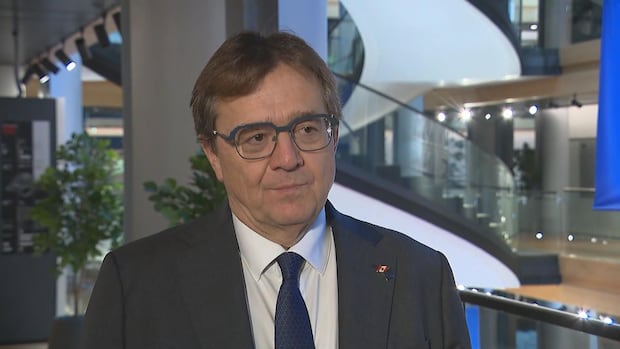
Jonathan Wilkinson, Canada’s incoming ambassador to the European Union, stated ‘we’re not there yet’ after European Commission President Ursula von der Leyen proposed the possibility of associate membership. ‘Our focus is on achieving tangible results,’ he added, mentioning that the government will ‘eventually’ address how to characterize their relationship.
“There are numerous terms that have been suggested to describe what this could entail. I believe we must reach a point where we clearly understand what we are defining,” Wilkinson explained to reporters after von der Leyen’s address.
“It’s about terminology; ultimately, there are many different ways to articulate it.”
Wilkinson reiterated that Canada is “not pursuing EU membership.”
Conservative Leader Pierre Poilievre criticized Carney for being inconsistent after von der Leyen’s mention of the “associate membership” concept in her speech.
“Conservatives are clear: we uphold the long-standing free trade and NATO defence alliance with Europe,” he stated on X.
“However, there should be no EU taxes, no EU regulations, and no EU open-border immigration policies imposed on Canadians.”
The Wall Street Journal article initially prompted a strong backlash from Poilievre, who commented on social media on Sunday evening that Carney “could not be more disconnected.”
“We will NEVER be the 51st U.S. state,” Poilievre asserted. “And we will NEVER become the 28th EU state.”
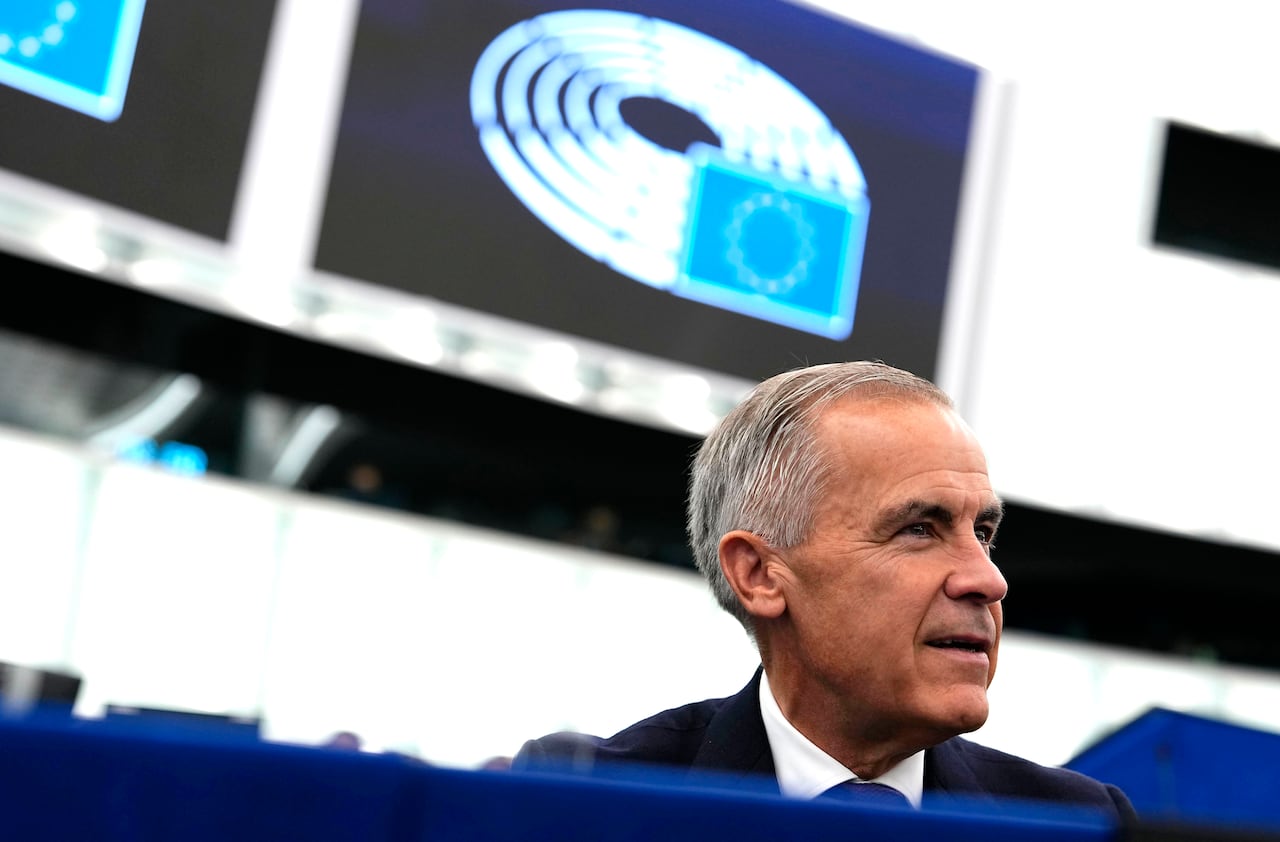
Prime Minister Mark Carney during the State of the European Union address in Strasbourg, France, on Wednesday. (Justin Tang/The Canadian Press)
Carney remained in the chamber for over an hour following von der Leyen’s address, listening to speeches from various political leaders.
Terry Reintke, the leader of the Greens-European Free Alliance group in the European Parliament, which holds seven percent of the seats, began her comments by expressing hope to see Carney in the chamber again in the future.
“You are very welcome in this house. I trust you are already feeling at home among the member states present, as we look forward to seeing you often,” Reintke stated.
- This week Cross Country Checkup is asking: Is Canada’s future aligned more with the United States or Europe? What implications would closer relations with the European Union hold for you? Share your thoughts here and your comments may be featured or you may receive a call back for Sunday’s show.
Thomas Byrne, Ireland’s minister of state for European affairs, sat next to Carney throughout the morning.
He commenced his speech by reflecting on their shared ancestry, noting that their grandfathers hailed from the same Irish county, both having served in the Irish police force.
“Your presence today visibly symbolizes the strong bond that exists between the European Union and Canada,” Byrne remarked.
“Thank you, President von der Leyen. Your proposal greatly enhances the relationship between the European Union and our esteemed friend, Canada.”