
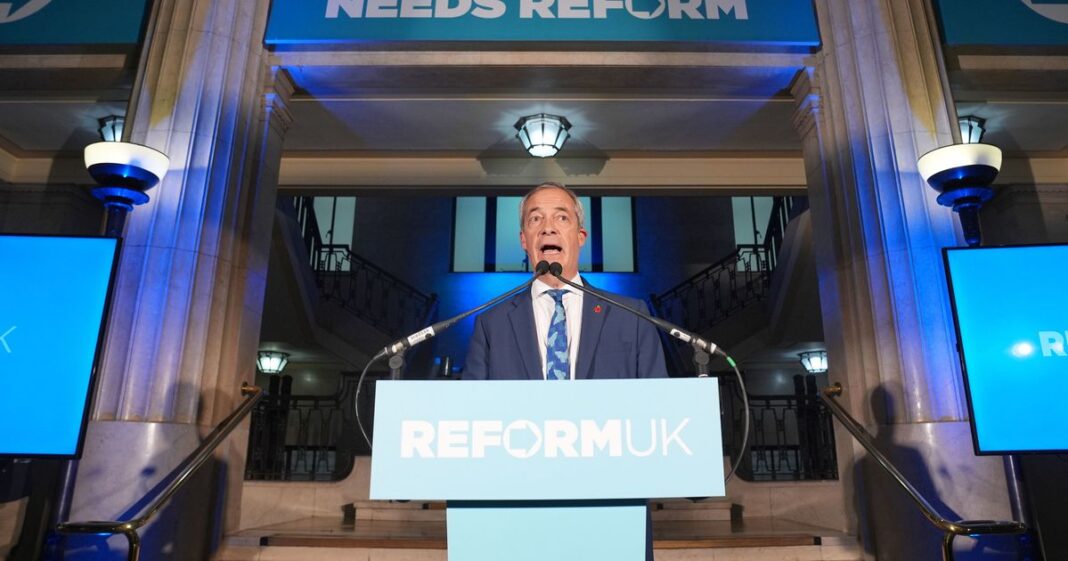

Nigel Farage predicts that a financial crisis will trigger a general election in 2027. The Reform leader, aiming to demonstrate his capability in managing the country’s finances, acknowledged the impracticality of significant tax cuts but remains firm on his proposal to introduce a special tax status for billionaires if he assumes the role of Prime Minister.
His proposals were previously criticized by the Institute for Fiscal Studies, which stated that the financial calculations in Reform’s manifesto were not feasible. Farage is anticipated to defend the decision to exit the EU, countering Rachel Reeves’ assertion that Brexit is responsible for the UK’s economic condition.
Farage declined to disclose his choice for Chancellor but emphasized that Reform is a collective effort and not reliant on one individual. He mentioned that the party is still in the process of determining key positions within the administration.
Addressing misconceptions regarding Reform’s welfare stance, Farage clarified that the party advocates for removing the two-child cap for British working couples to alleviate financial burdens. Additionally, he reiterated his controversial proposal to offer a “golden ticket” tax status to foreign billionaires, emphasizing the importance of retaining high-earning individuals in the UK to sustain the economy.
Regarding the financial sector, Farage praised the significance of the industry in Britain and criticized the obstacles posed by HR and compliance regulations. He lamented the perceived failure to capitalize on the benefits of Brexit, attributing the current economic challenges to missed opportunities for deregulation and global competitiveness.
Farage forecasted an economic downturn leading to a general election in 2027, expressing dissatisfaction with the current taxation policies and business regulations. In response, Labour criticized Reform UK’s economic strategy, labeling it as a return to austerity measures with no concrete plans for improvement.
In his upcoming speech, Farage is expected to advocate for reduced business regulations post-Brexit, emphasizing the need for deregulation to enhance competitiveness. Rachel Reeves, the current Chancellor, has introduced reforms aimed at simplifying regulations and supporting British businesses while attributing the economic downturn to Brexit’s impact.
Keir Starmer has also emphasized the importance of reducing regulatory burdens to encourage investment and economic growth. Last year, Reform UK proposed significant tax cuts in their “contract” with voters, including raising the income tax threshold and abolishing inheritance tax, although these plans were met with skepticism from economists due to financial feasibility concerns. Farage is set to renounce the £90 billion tax cut promise following criticism from various quarters.