
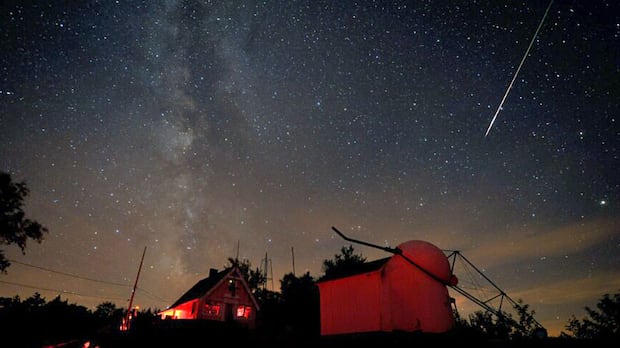

Every August brings one of the most impressive meteor showers of the year known as the Perseids. This year, the peak night of the shower coincides with a partial solar eclipse.
The Perseid meteor shower is highly anticipated for its abundance of bright meteors and favorable viewing conditions. The peak viewing night is set for Aug. 12-13, coinciding with a new moon phase, ensuring optimal visibility without interference from moonlight.
Peter Brown, a professor at Western University, highlighted the presence of Earth-grazers during this year’s Perseid shower. Earth-grazers are meteors that enter the atmosphere and swiftly return to space, often appearing bright and fast, creating a spectacular sight for observers.
The shower is expected to peak around midnight Eastern Daylight Time, potentially showcasing up to 120 meteors per hour, although ideal viewing conditions are required to witness such numbers.
To enhance the viewing experience, experts recommend finding a dark-sky location, avoiding phone use to allow eyes to adjust to the darkness fully, and observing the Perseus constellation, which marks the radiant point of the meteors.
Apart from the Perseids, other meteor showers such as the southern delta Aquariids and alpha Capricornids are also active, offering additional opportunities to witness shooting stars. Moreover, a partial solar eclipse on Aug. 12 will be visible across certain regions, providing a unique celestial event for spectators.
It is important to exercise caution while observing the partial solar eclipse and use approved solar eclipse glasses to protect the eyes from harmful sun rays. Astronomers emphasize the educational value of solar eclipses in showcasing the dynamic interplay between the Earth, moon, and sun in the celestial realm.