
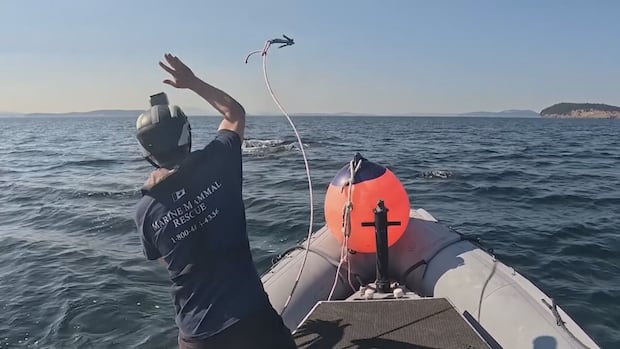

Marine mammal rescuers operating on Vancouver Island have reported a busy summer dealing with whale entanglements. Paul Cottrell, who serves as the marine mammal coordinator for Fisheries and Oceans Canada, stated that his team has responded to an average of one to two entanglements per week over the past two months. This rate is consistent with the numbers seen last year, with several necropsies also conducted.
The most recent incident occurred last week, marking the third activation of Cottrell’s team in less than two weeks. A humpback whale calf, along with its mother, was discovered near the south coast of Vancouver Island ensnared in over 100 meters of rope. Cottrell mentioned that the calf had been dragging the rope since July 5, when it went missing from British Columbia’s central coast. The team, in collaboration with U.S. counterparts, spent seven hours untangling the calf.
Cottrell highlighted the significance of saving each animal, emphasizing the team’s satisfaction in assisting the calf. Prior to this rescue, there were two entanglement calls within two days. The team worked tirelessly to free a whale named Wiggins for the second time in a year near French Creek on the eastern coast of Vancouver Island before rushing to the central Island and the Alberni Inlet for another call.
The frequency of entanglements is on the rise, with no indication of a decline in rates. Cottrell noted the increasing number of humpbacks in British Columbia’s inshore waters, a positive aspect known as the “humpback comeback,” but expressed concerns about the entanglement risks associated with inshore fishing gear.
Jackie Hildering, a researcher and educator at the Marine Education and Research Society (MERS), praised the conservation efforts that have provided humpback whales with a “second chance” after being nearly wiped out by hunting. However, she cautioned that this opportunity is being jeopardized. Hildering stressed the severity of the entanglement issue, mentioning that 50% of whales she has observed through her research show signs of past entanglements, likely underestimating the actual figures.
She advocated for a shift towards prevention and education as more effective strategies, believing that disentanglements, while making headlines, do not provide a lasting solution. Hildering highlighted the importance of informing individuals on how to prevent humpback entanglements and fatalities, endorsing MERS’ whale-safe boating course, which has received federal government approval.