
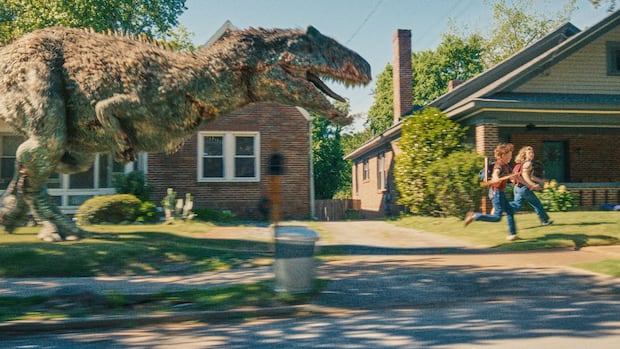

In a suburban neighborhood, unusual scenes unfold as a massive snake-like creature emerges from a neighbor’s pool, followed by feathered lizards chasing a family down their driveway. The movie, “The End of Oak Street,” capitalizes on dinosaur fascination and nostalgia for “Jurassic Park,” offering a fresh take on prehistoric creatures more aligned with paleontological insights.
The film showcases dinosaurs with abundant feathers, a departure from Hollywood’s traditional scaly depictions. Paleontologists, such as Victoria Arbour from the Royal B.C. Museum, appreciate this shift, highlighting the evolving scientific understanding of dinosaurs’ appearance. Fossil discoveries since the 1990s have revealed that many non-avian dinosaurs likely had feathers, challenging the conventional portrayal of scaly creatures in popular culture.
“The End of Oak Street” introduces various dinosaur species with realistic feathered features, drawing from recent scientific discoveries. While some creatures in the movie, like the Allosaurus and smaller feathered dinosaurs, align with known species, others, such as the legless aquatic creature, venture into creative speculation not supported by the fossil record.
The film also explores the mating behaviors of dinosaurs, a topic of mystery due to the scarcity of direct evidence in the fossil record. Director David Robert Mitchell’s unconventional portrayal of dinosaur mating in the movie sparks curiosity, reflecting the ongoing scientific debate and speculation surrounding this aspect of dinosaur behavior.
Despite the artistic liberties taken in depicting dinosaur interactions, the film’s portrayal remains within the realm of scientific plausibility, according to experts. The complexities of dinosaur reproduction and behavior continue to intrigue researchers, as the study of these ancient creatures relies on interpreting limited fossil evidence and extrapolating insights into their lives and interactions.