
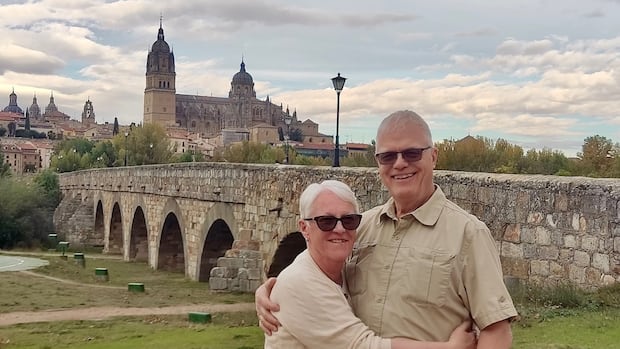

After viewing a television program featuring a total solar eclipse in Antarctica back in 2003, Stephen Bedingfield from Yellowknife was inspired to pursue witnessing every eclipse possible. This week, he and his wife traveled to Spain to witness his 13th total solar eclipse, marking his 23rd eclipse when including partial ones. The event was anticipated to last approximately two minutes.
Bedingfield described the total solar eclipse as a breathtaking experience, likening it to seeing iconic natural wonders like the Great Barrier Reef, Niagara Falls, and Mount Everest simultaneously. Although the total solar eclipse was visible in Greenland, Iceland, Spain, and northern Russia, with a small part of Portugal also catching a glimpse, only a partial solar eclipse was observable from Canada, where the moon would partially obstruct the sun.
Throughout his two-decade pursuit of solar eclipses, Bedingfield has formed connections and found a community of fellow eclipse chasers. He emphasized the unique thrill of participating in this global phenomenon and the opportunity it provides to explore diverse cultures and locations worldwide.
Bedingfield highlighted the transformative impact of a solar eclipse on the environment, noting sudden drops in temperature and changes in wildlife behavior. He underscored the holistic environmental experience that accompanies witnessing such a celestial event.
Christa Van Laerhoven, the vice president of the Yukon Astronomical Society, advised viewers in Yellowknife, Whitehorse, and Iqaluit to use proper eye protection when observing the partial eclipse. She recommended utilizing approved solar eclipse glasses or creating at-home pinhole projectors using simple materials like empty boxes, foil, and white paper. Natural objects like leafy trees with holes can also serve as makeshift pinhole projectors.
Van Laerhoven dispelled the misconception that the sun is more hazardous during a solar eclipse, warning against direct sun gazing at any time. She cautioned that the temptation to look at the sun during a partial eclipse could lead to eye damage, emphasizing the importance of safe viewing practices.