
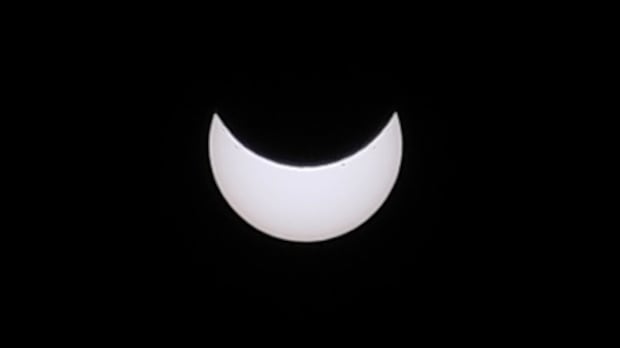

On Wednesday afternoon, residents of Newfoundland and Labrador had the opportunity to witness a partial solar eclipse depending on the weather conditions. The partial eclipse began in Churchill Falls at 1:37 AT (2:07 NT) and gradually progressed across the province, concluding in St. John’s at 4:37 p.m. NT. Observers in Newfoundland could anticipate the moon covering about 50% of the sun, with the extent of the eclipse varying by location.
At the Johnson Geo Centre in St. John’s, a group of enthusiasts gathered to watch the spectacle through special safety glasses. The event, organized by the Royal Astronomical Society of Canada and STEM Girls, took place from 12 p.m. NT to 5 p.m. The onlookers were captivated as they observed the moon moving across the sun, with astronomer Hiding Neilson from Memorial University describing the experience as “wonderful.” Neilson highlighted the rarity of the event, noting that such partial eclipses occur approximately every 50 years.
The lead of education and interpretation at the Geo Centre, Andrea van Nostrand, expressed excitement about the eclipse activities for children and emphasized the spectacular nature of the event. Meanwhile, elsewhere in the world, a total solar eclipse was set to be visible in Greenland, Iceland, Spain, and a small portion of Portugal. This celestial event inspired mother-daughter duo Jennifer Waye and Gabriela Fuentes Waye to travel to Spain to witness the total eclipse, drawn by the country’s favorable weather conditions.
In Canada, regions further north and east, such as Alert, Nunavut, were expected to witness a more complete solar eclipse, with the sun being 94% obscured. The unique astronomical phenomenon drew spectators and enthusiasts alike, showcasing the beauty and wonder of the natural world.