
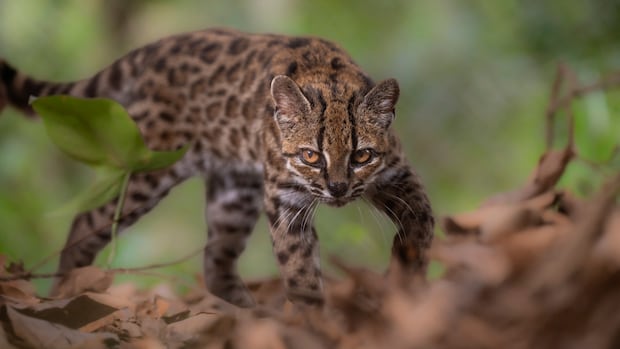

A small wild cat living in Bolivia’s cloud forest has been recognized as a new species, marking the first formal naming of a living cat species in over a century. Referred to as Tilcayo by locals, this cat belongs to a group known as tiger cats found in various parts of South America. Discovered in Bolivia’s Yungas forest, the cat measures approximately 46 centimeters in length and weighs around three pounds, making it smaller than the average household cat.
Genetic analysis confirmed the cat as a distinct species, and it was given the scientific name Leopardus tilcayo while retaining its local name. The cat’s fur is light brown with irregular rosettes on its body, as described by Paola Nogales Ascarrunz, one of the authors of the study published in the journal Current Biology.
Little is known about the cat’s habits, but evidence from scat samples suggests it preys on small rodents, and camera traps indicate it may be more active during the night. Tiger cats are considered cryptic species, challenging to differentiate based solely on appearance, according to evolutionary biologist Jonas Lescroart.
The study revealed the existence of five genetically distinct tiger cat species, including the newly identified Tilcayo lineage. The researchers also identified a new tiger cat subspecies in Peru’s Yungas, named Leopardus tigrinus antisuyo after the region it inhabits within the old Inca Empire.
The International Union for Conservation of Nature currently classifies tiger cats as two vulnerable species with declining populations. The researchers anticipate that the separate assessment of the five tiger cat lineages could lead to a more accurate risk assessment, potentially categorizing species like the Tilcayo as endangered on an individual basis.
Efforts to protect the Yungas ecosystem, one of the most threatened in the region, are crucial due to mounting pressures from deforestation, agriculture, fires, and mining activities. Restoring damaged forest areas, preserving native habitats, and maintaining connectivity between ecosystems are urgent priorities to safeguard these newly discovered species at risk of extinction.