
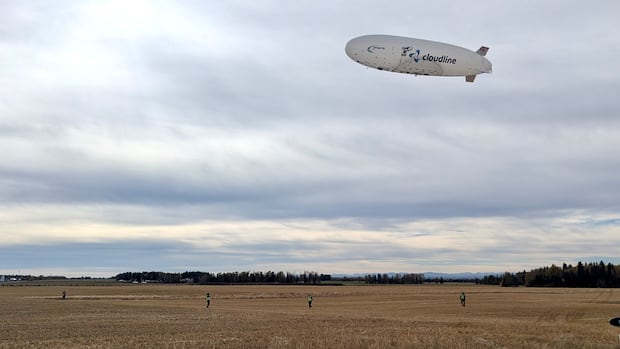

Last week, central Alberta witnessed a rare spectacle in the sky that caught the attention of many: a 20-meter-long blimp. While a Goodyear Blimp might be a familiar sight at sporting events, spotting such an aircraft in rural Alberta is quite unusual.
The blimp in question was a solar-powered airship, comparable in size to a school bus, conducting tests to gather aerial survey data near Rocky Mountain House, approximately 200 kilometers southwest of Edmonton. Cloudline, a South African aerospace company that produced the airship, collaborated with its Canadian operational partner, 3 Points in Space Media, to perform flight trials from the Rocky Mountain House Airport.
Describing the airship, Sean Adams, the founder and CEO of 3 Points in Space Media, likened it to a helium party balloon and highlighted its unique feature of being an autonomous airship due to the integration of control systems. Adams emphasized the novelty of this technology compared to traditional blimps.
Pre-flight preparations involved filling the airship’s envelope with helium and completing diagnostic checks while the aircraft was tethered. Following clearance, operators released the airship for calibration runs before embarking on long-distance survey missions. According to Adams, the airship, classified as a remotely piloted aircraft system, is equipped with automated flight controls, making it ideal for data collection in remote areas like pipeline and infrastructure monitoring.
Despite the advantages of airships in carrying heavier camera and LiDAR sensors over greater distances than standard drones, Adams acknowledged that crewed aircraft are better suited for extreme weather conditions. The collaboration between Cloudline and TC Energy aims to explore the potential of collecting various data types efficiently and quietly using airships.
Michael Adams, the vice-president of research and development at 3 Points in Space Media, expressed enthusiasm for revitalizing airship technology, which saw a decline in popularity after the Hindenburg disaster in the 1930s. By incorporating a piece of fabric from the historic Graf Zeppelin in their operations, Adams sought to blend the past with the future in aviation technology.
The presence of the airship generated significant interest in the Rocky Mountain House area, with locals marveling at the unusual sight. Mayor Shane Boniface shared that the airship attracted more attention on social media than a recent tornado incident. Although Cloudline operates airships globally, these autonomous airships are still a rare sight in Canadian airspace.
Upcoming plans for the flight team include conducting cold-weather tests in northern Ontario to prepare the airship for operations in sub-zero temperatures and Arctic conditions.