
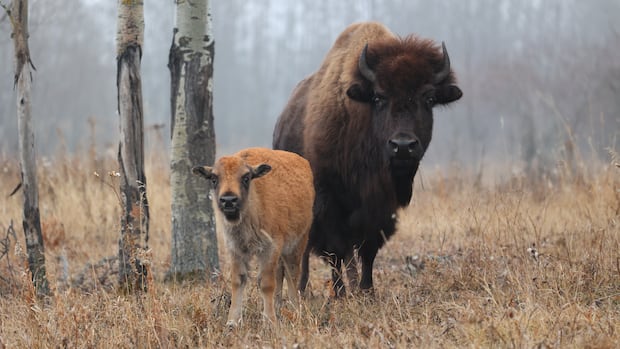

In the past, bison roamed freely across North America in large herds characterized by their rust and auburn fur, before facing near extinction due to hunting.
Newly decoded DNA information on bison sheds light on how their populations collapsed and slowly returned to the landscapes they once dominated.
Published in the journal Science, a study involving 160 bison genomes was conducted, tracing back their genetic history over 20,000 years.
Led by paleogeneticist Jonas Oppenheimer and the Paleogenomics Lab at the University of California, Santa Cruz, the research involved nearly 40 scientists, mostly from Canada, specializing in ancient DNA extracted from fossil remains.
The aim of the research is to assist modern conservation efforts by utilizing the genetic history of bison to enhance their survival prospects.
Historically well-connected, bison populations are now isolated in managed groups, posing challenges to their resilience.
According to Oppenheimer, bison were genetically similar across North America until recently, highlighting the impact of human-induced near-extinction events on their genetic diversity.
The genetic analysis, involving both ancient bison bones and DNA from living herds, revealed how the species’ biological diversity has evolved over time.
Researchers collected DNA samples from managed herds in Canada and the United States, as well as from wild herds in northern regions of the provinces.
By sequencing 115 ancient bison genomes and 45 modern ones, along with data from previous studies, the researchers created the most extensive genetic map of the species.
Chris Jass from the Royal Alberta Museum emphasized the importance of ancient fossils in understanding genetic changes and collaborative efforts in research.
The study also showed that the genetic diversity of bison was affected by historical declines in population, contrary to initial assumptions.
Wood bison and plains bison were found to be distinct species, diverging around 3,000 years ago due to environmental changes.
Efforts are underway to preserve the distinct genetic heritage of bison subspecies, emphasizing the need for separate management strategies.
The study highlighted the importance of genetic data in managing bison herds effectively and suggested strategies to enhance genetic diversity and prevent inbreeding.
Reconnecting isolated herds and restoring genetic diversity is crucial for the long-term conservation of bison populations, according to the researchers.
Ancient genomes serve as a reference point for maintaining genetic diversity and guiding the reintroduction of bison into natural habitats.
Tag: rewrite-pending