
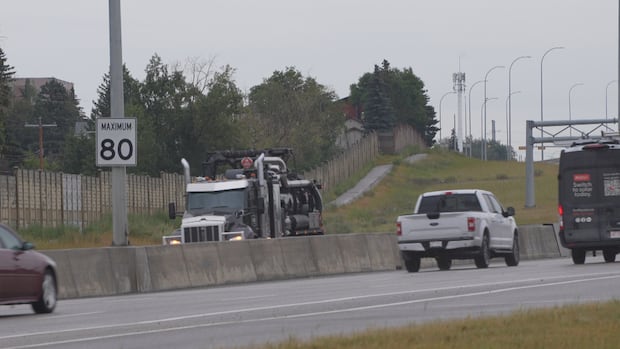

Residents of the Riverbend community in the southeast are voicing their worries about traffic noise along Glenmore Trail, claiming that the current sound wall fails to sufficiently block the disruptive sounds.
“It’s so loud that my kids complain when their windows are open,” remarked Nichole Walczak, a Riverbend resident. “Occasionally, the noise even wakes them up during the night or early morning hours.”
Another local, Amanda Blackmore, expressed that entertaining guests has become “embarrassing,” as conversations in the backyard turn into shouting matches due to the noise.
“You can’t hear anything, so I’m constantly yelling at people, and they don’t want to return because it’s uncomfortable to have a decent conversation with all the loud noise in the background,” she commented.
A sound barrier intended to mitigate traffic noise is situated along the expressway adjacent to their community.

Nichole Walczak (left) and Amanda Blackmore (right) say they avoid spending time in their backyards with family and friends because the traffic noise is too disruptive. (Brendan Coulter/CBC)
However, residents assert that it is no longer effective in diminishing the noise, prompting them to request the city to either increase its height, widen it, or replace it entirely.
“We’ve noticed that the noise has escalated significantly, and we are trying to collaborate with the city to address this issue and explore solutions to reduce the sound,” shared resident Kathleen Schroeder.
Schroeder mentioned that she and her neighbors have taken measures to cope with the noise themselves, such as installing double or triple pane windows, relocating to different areas of their homes for sleep, or using thicker curtains to help absorb sound.
“We make an effort to leave our homes, go for walks, and try to stay away from the wall. But that’s about all we can do for now,” she added.
Both Schroeder and Blackmore indicated that the area was noticeably quieter before the widening of Glenmore Trail was completed in 2019. They link the increased noise levels to the city’s expansion, which has led to a surge in traffic.

Riverbend resident Kathleen Schroeder requested the city conduct a noise test in the area. The study found sound levels in one area of the community exceeded the acceptable limit of 65 decibels for residential spaces. (Brendan Coulter/CBC)
In June, the city initiated a traffic noise evaluation in the neighborhood, revealing that sound levels in one section surpassed the acceptable 65-decibel threshold for residential areas.
Schroeder was the one to request the assessment, which residents can initiate through the city’s noise barrier program. She expressed that the results of the study validated her concerns.
“I felt reassured, realizing that I wasn’t just an overly concerned citizen,” she remarked.
The city’s website states, “noise barriers are evaluated for replacement or repair based on condition survey data,” and they are prioritized according to the budget available.
The city conducts regular inspections of noise barriers, with those deemed in good or acceptable condition being checked every two years. Barriers in poor condition are inspected annually.
A list is compiled of noise barriers that require replacement or repair.
During the 2023-2026 budget cycle, city council allocated $6.12 million for the repair and replacement of noise barriers.
However, Riverbend is not the only neighborhood facing excessive noise challenges. The evaluation identified six additional communities that qualify for noise barrier enhancements.
-
City launches new traffic safety initiative targeting excessive vehicle noise
-
Traffic noise in Riverbend renders backyard ‘almost useless,’ says resident
The city indicated that these locations will be prioritized based on noise levels, the number of residents affected, and the amount of funding approved in the subsequent budget cycle.
Schroeder hopes for prompt changes but sees the assessment as a positive initial step.
“Knowing that the city has recognized noise as an issue is a significant advancement toward resolving this problem,” she concluded.