
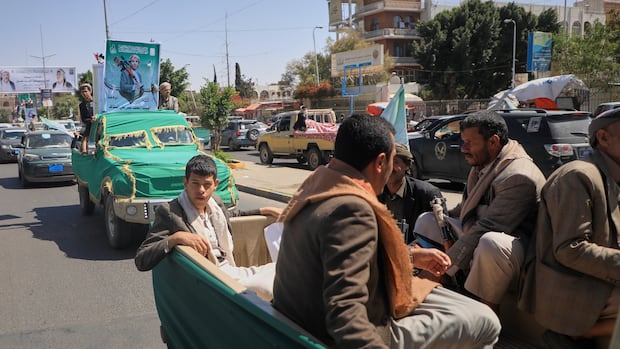

Saudi Arabian air forces targeted Yemen, while Houthi militants retaliated by launching drones and missiles aimed at cities in Saudi Arabia, as reported by the Iran-supported group on Wednesday. This escalation follows a rapid advance that has increased Tehran’s influence in the ongoing conflict in the Middle East.
In response to the escalating situation, the United States issued a more stringent travel advisory for Saudi Arabia, prohibiting government personnel from traveling within 32 kilometers of the Yemeni border.
The Houthis have made significant territorial gains over the past week, capturing Yemeni towns along the Red Sea and taking control of islands in the Bab el-Mandeb Strait. They released a video showing their fighters seizing armored vehicles from forces allied with Saudi Arabia, as warplanes flew above and massive explosions erupted from the desert.
Houthi military spokesperson Yahya Saree announced that the group had conducted new drone and missile attacks on the key Saudi Red Sea oil port of Yanbu and a southern airbase in Khamis Mushait, although he did not specify when these attacks occurred.
Both Yanbu and Khamis Mushait were included in a list of locations where Saudi Arabia issued alerts on Tuesday, although no similar warnings were made on Wednesday.
Saudi officials and the oil giant Aramco did not immediately reply to requests for comments.
Earlier, Saree claimed that the Houthis had downed a Saudi F-15 fighter jet, but no immediate proof of this incident has been provided.
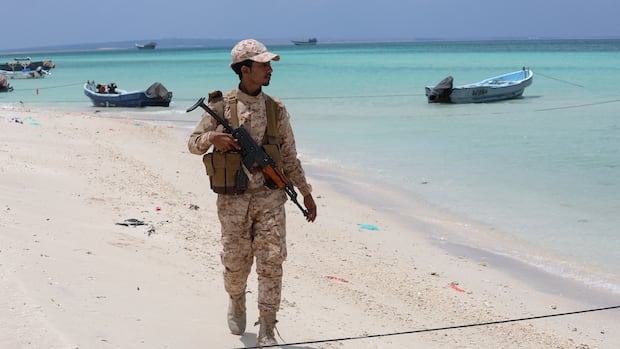
Iran-backed Houthi rebels in Yemen are expanding their control over a key Middle Eastern shipping route, adding further pressure to global oil supplies and prices.
Saree further stated that the Saudis had conducted approximately 450 airstrikes on Yemen this week. Officials from the Saudi-aligned government in southern Yemen confirmed that they, along with Saudi forces, were carrying out airstrikes against Houthi positions, although Riyadh has yet to officially acknowledge these actions.
In the past week, the Houthis have repeatedly targeted Saudi Arabia, raising alarms in cities located in the south and west. An attack attributed to Iran-aligned fighters in Iraq last week also resulted in damage to the East-West pipeline, a crucial route for diverting oil exports from the blocked Strait of Hormuz.
Riyadh reported that its air defenses intercepted a Houthi drone south of Mecca on Tuesday before it could breach restricted airspace above the holy city, labeling the incident a violation of a “red line” that threatens sites sacred to Muslims.
Saree denied that the Houthis had any intention of targeting Mecca, claiming that the Saudi assertions were merely a pretext for propaganda.
Sources informed Reuters that U.S. officials met with the Houthis over the weekend in Oman, during which the group reaffirmed its commitment to a ceasefire established last year with the U.S. and stated it had no plans to attack American vessels.
Risk of escalating global energy shortage
The expansion of the conflict into Yemen poses a significant risk of exacerbating the global energy supply crisis that has arisen from the six-month-long U.S.-Israeli conflict with Iran, disrupting shipping through the Strait of Hormuz.
On Wednesday, the price of Brent crude oil stayed around $108 US per barrel, nearing its highest price since May. In the United States, the average retail price for diesel fuel reached a record high of over $6.30 US per gallon for the first time.
Market analysts indicate that a prolonged shutdown of Saudi Arabia’s East-West pipeline could potentially eliminate up to four percent of the global oil supply. Although Saudi Arabia has not specified when operations might restart, U.S. Energy Secretary Chris Wright mentioned on CNBC that crude oil should resume flowing through the pipeline shortly.
Since 2015, Saudi Arabia has led a coalition against the Houthis. While the conflict had mostly remained subdued under a ceasefire in recent years, it reignited when the Houthis imposed a naval blockade against Saudi Arabia in July and targeted southern areas of the kingdom. Violence has escalated significantly this month as the militant group pushed back forces affiliated with the internationally recognized Yemeni government supported by Saudi Arabia.
Last week, Saudi Crown Prince Mohammed bin Salman reached out to U.S. President Donald Trump for military assistance, which has thus far been limited to intelligence support.
-
Houthis attack more Saudi targets as regional talks with Iran postponed
-
Houthis seize strategic island, Saudis close pipeline as fighting escalates
The United States conducted airstrikes against the Houthis for two months in 2025 but halted these actions after what Trump described as a ceasefire that would prevent assaults on vessels.
Trump now faces a dilemma: whether to remain passive and risk the Houthi advance worsening the global energy crisis or to provide more direct military assistance to the Saudis, which could extend U.S. involvement into another conflict zone.