
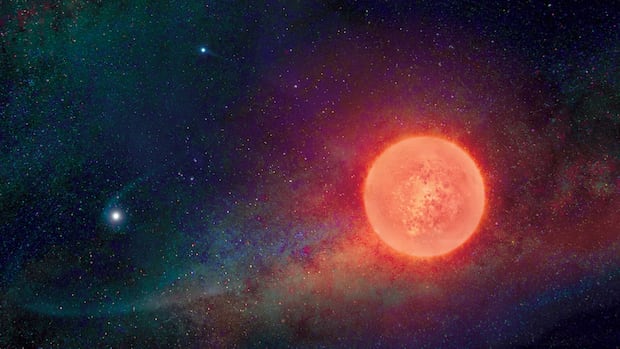

Located approximately 28 light-years from our planet is an intriguing star system known as IRAS 21500+5903.
Astronomers had been aware of the two stars that revolved around each other for many years. However, while searching for exoplanets—those planets that orbit stars beyond our solar system—a team of astronomers stumbled upon an unexpected revelation: there was, in fact, a third star within the system. Rather than a binary star system, it turned out to be a triple-star system.
“It’s a bizarre occurrence. It was a frustrating object,” remarked Étienne Artigau, a researcher at the Trottier Institute for Research on Exoplanets (IREx) at the University of Montreal. “It wasn’t what we were aiming to find.”
Their results were published this week in the journal Astronomy & Astrophysics.
The system consists of a red dwarf, a type of star frequently found in our galaxy, along with two smaller, denser white dwarfs. One white dwarf is situated approximately 1,000 astronomical units (the distance from the Earth to the Sun) from the red dwarf, while the other is merely two astronomical units away, resembling the distance from the Sun to Mars.
The inner white dwarf revolves around the red dwarf, while the outer white dwarf circles around the pair.
An unusual neighbor
What is remarkable is that no one had identified it over the years.
“It’s strange that this system went unnoticed, but it also suggests that there are unusual phenomena just nearby,” Artigau noted. “It’s not exactly next door, but rather just down the street, a block away in the stellar neighborhood.”
When a low- to medium-mass star reaches the end of its life cycle, it first expands into a red giant before eventually leaving behind a small, dense white dwarf. This is the fate awaiting our own Sun in about five billion years.
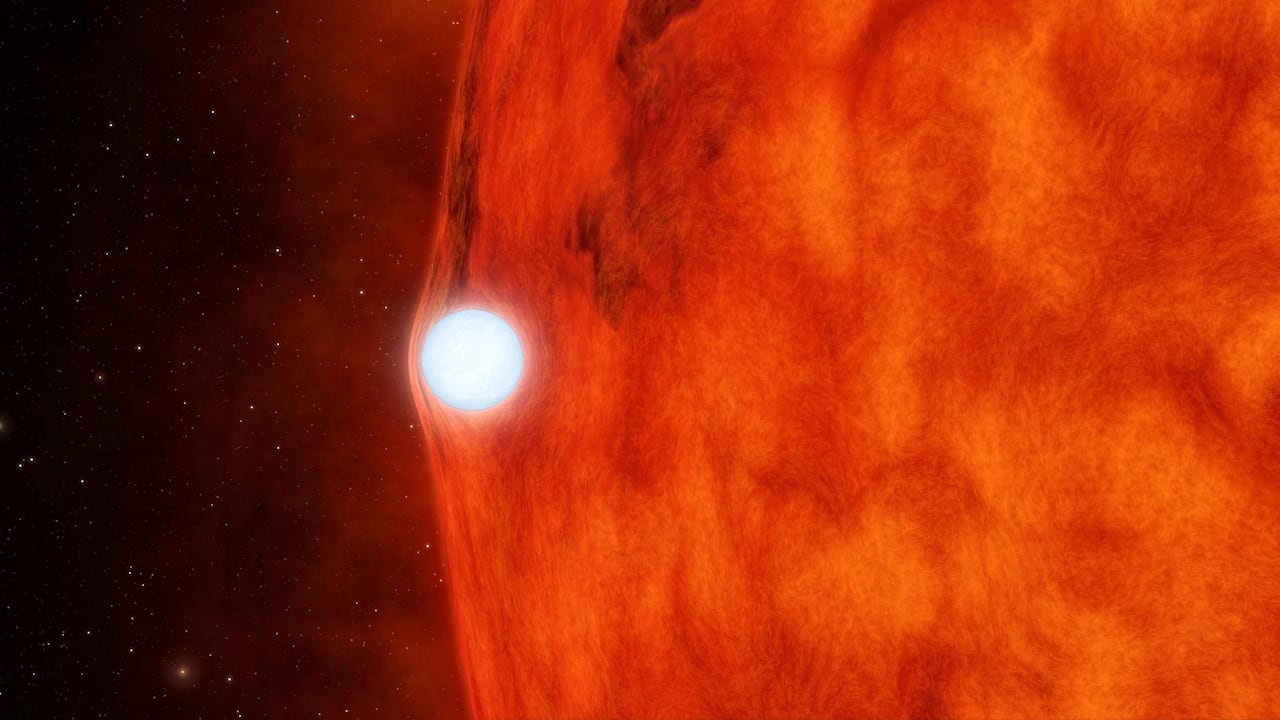
This artistic illustration depicts an ultra-dense dead star, known as a white dwarf, transiting in front of a small red star. (NASA/JPL-Caltech)
While searching for an exoplanet within this system, the international astronomer team—led by the University of Montreal—utilized an instrument at the Canada-France-Hawaii Telescope in Maunakea, Hawaii, called SPectropolarimètre InfraROUge (SPIRou). This device detects exoplanets by measuring slight variations in a star’s velocity, which can be influenced by orbiting planets.
However, the red dwarf exhibited unexpected behavior. It was moving in ways that differed significantly, with velocity fluctuations nearing 16 kilometers per second, a substantial deviation.
At first, they speculated that it might be a brown dwarf, a type of substellar object with a mass around 75 times that of Jupiter.
Yet, this explanation still seemed off.
More peculiarities
The velocity discrepancies were so pronounced that they caused Artigau’s calculations to malfunction.
“At one point, we thought, okay, we need to resolve this. Something is amiss with that object. So I revised the code,” he explained. “Then we realized, let’s recalculate the brown dwarf. No, that doesn’t add up either.”
It truly was a puzzling situation.
-
Are we alone? Institute searching for alien signals is using a new way to answer that age-old question
-
Astronomers think they’ve captured a planet forming around a host star — something never seen before
Ultimately, they concluded that the source of the disturbances was a high-mass object, albeit one that remained invisible.
Could it be a black hole? A neutron star? A white dwarf?
The team then turned to the Gemini North telescope, also situated in Maunakea. Utilizing high-resolution images from its ‘Alopeke instrument—a specialized high-speed camera—they finally located what they needed: a distant companion star—a white dwarf—orbiting closely around the red dwarf.
And then it got even stranger.
Prior to becoming a white dwarf, the star would have expanded into a red giant. As it bloated, its orbit would have been so near to the red dwarf that the two must have interacted significantly. Often, such stars engulf the red dwarf, or the two might even merge—but that did not occur here.
Moreover, there was additional oddity.
The inner white dwarf should be spiraling inward towards the red dwarf, but instead, it maintains a stable orbit.
It is possible that the more distant white dwarf is somehow maintaining this stable orbit, although the exact mechanism is still unknown and will require further investigation.
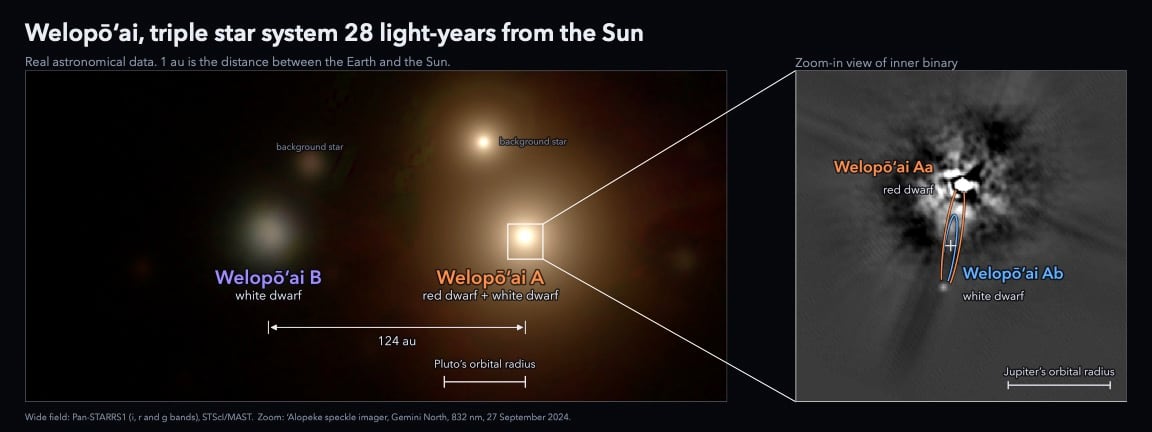
The image on the left depicts the two components of the system: Welopō’ai A, a closely orbiting red dwarf and white dwarf pair, and Welopō’ai B, a second white dwarf situated farther away. The image on the right provides a detailed view of the inner pair and their orbital trajectories. (Pan-STARRS1/STScI/MAST, left, International Gemini Observatory/NSF NOIRLab, right. Graphical construction by Étienne Artigau & Heidi White (UdeM/IREx))
“We’re asserting that it shouldn’t exist,” Artigau commented. “Yet, it undeniably exists. It is there.”
Paul Delaney, a professor emeritus of physics and astronomy at York University in Toronto, believes that the more distant white dwarf may have originated much closer to the other two.
“When planetary systems form today, migration is a typical phenomenon,” he stated. “I would wager that they were relatively close and engaged in some gravitational interaction, leading to the present white dwarf being much nearer in its earlier stages.”
Adding to the peculiarities, the astronomers estimated that this system is approximately 10 billion years old, which is older than our solar system’s 4.6 billion years, and its stars are metal-rich, contrary to the common expectation that older stars are metal-poor.
“It’s fascinating, and we’re uncertain what it implies. It may just be a random occurrence in a stellar population,” Artigau remarked.
Continuing the search for exoplanets
The astronomers have named this system Welopō’ai, derived from the Hawaiian words “welo,” meaning an inherited family trait, and “pō’ai,” which signifies an orbit or circular path. Thus, the name translates to “path of family traits.”
The well-known book and Netflix series 3 Body Problem explores a triple-star system and the implications it might have for a nearby planet, particularly for a civilization that has evolved there.
In the show, one term used to describe the triple-star system is “chaotic,” highlighting its impact on the rate of civilization’s development.
This issue is a long-standing physics dilemma. Two-body systems are predictable, but introducing a third body complicates everything. This is because Body A exerts gravitational influence on Body B and Body C, while Body C, in turn, affects the motions and forces of Bodies A and B, leading to perpetual changes.
While the researchers did not identify any exoplanets, Artigau mentioned that the quest is far from finished.
“This system is so peculiar that Atanas Stefanov, one of the authors, is requesting time to search for planets around the red dwarf,” he stated.
The existence of a planet there, or the potential for an alien civilization to thrive in a triple-star system, remains uncertain.
For Artigau, the emergence of something novel in his research was exhilarating.
“I enjoy it,” he expressed. “Discoveries that are unexpectedly sideways in your research are exciting.”