
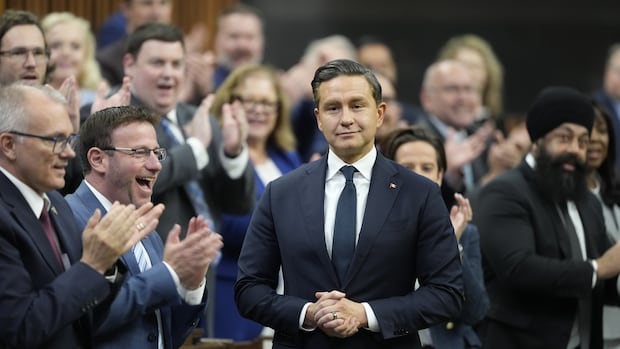

As Members of Parliament return to Ottawa on Monday, the federal Conservative Party finds itself as the Opposition striving for relevance in a national dialogue largely overshadowed by U.S. President Donald Trump’s trade conflict with Canada, alongside public scrutiny of Prime Minister Mark Carney’s interactions with the White House.
In a press conference before his caucus meeting in Penticton, B.C., the leader of the Official Opposition provided a glimpse of their strategy.
“The Canadian dream—that through hard work you can achieve a fulfilling life, own a home, afford food, and live on a safe street—has been shattered after 11 years under Liberal leadership,” Pierre Poilievre stated in Vancouver on Tuesday.
His focus was on the theme of affordability, a strategy that proved effective when Carney’s predecessor, Justin Trudeau, held the Prime Minister’s Office.
However, pollster David Coletto notes that Canadians are currently hesitant to attribute the blame for soaring costs to Carney.
“The immediate blame is not directed at Ottawa or Mr. Carney; it’s Donald Trump,” remarked Coletto, CEO of Abacus Data.
Recently, Poilievre has shown an increased awareness of Trump’s enduring influence over Canadian sentiment.
He made a trip to New York, appearing on both Fox Business and CNBC.
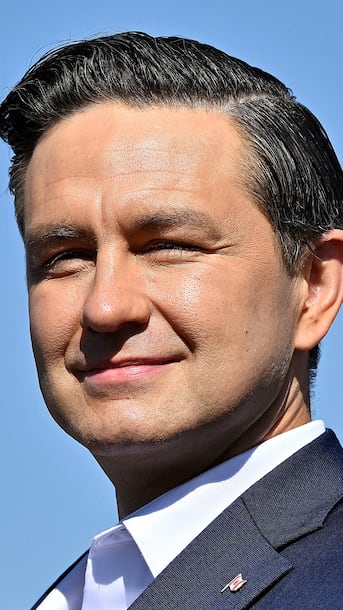
Conservative Leader Pierre Poilievre appeared on CNBC’s Squawk Box telling Americans he won’t ‘attack his prime minister on foreign soil’ amid the ongoing trade war. Poilievre said Canadians are feeling ‘wounded’ and ‘confused’ over how Canada and its economy became a key target for U.S. President Donald Trump.
However, acknowledging the issue is one thing; finding a resolution is another.
“How do you stay relevant when most Canadians perceive the greatest threat to their lives as coming from the United States, and when they largely believe that the prime minister and the Liberal Party are best equipped to manage it?” Coletto questioned.
Coletto, who meticulously observed the Conservatives’ previous surge in public support prior to its decline during the 2025 federal election campaign, indicated that the Official Opposition is facing its lowest polling figures in nearly a decade, with the Liberals leading by 14 points.
“It’s about finding a way to manage the internal voices within your party that are resistant to aligning with Team Canada and are uncomfortable with certain Liberal actions,” he added.
‘Difficult’ conversations welcome: Conservative MP
Just last week, commentators within the party expressed surprise when one of Poilievre’s MPs, Jamil Jivani, openly advocated for a more conciliatory approach in relations with the U.S.
“We find ourselves in a situation where Canadians who disagree with Liberal policies are being labeled traitors, while those who should be presenting an alternative to the Liberals are instead seeking to appease those in power,” Jivani stated, seated before a Canadian flag in a video shared on his social media platforms.
A former university roommate of U.S. Vice-President JD Vance, Jivani likened the Liberals’ response to the trade war to their largely unchallenged management of the COVID-19 pandemic, while advocating for a stronger relationship with the United States.
“We need you to remain steadfast, maintain your resolve, and resist the pressure to believe there’s only one way to solve our nation’s challenges,” he urged.
Although he refrained from directly naming Poilievre, his message was unmistakable to Dimitri Soudas, who served as spokesperson for former Conservative Prime Minister Stephen Harper.
“Not a single word criticizing Donald Trump, nor a word of praise for Pierre Poilievre. Sometimes a politician’s silence speaks volumes,” Soudas remarked on X.
Former Alberta Premier Jason Kenney, who was in Harper’s cabinet alongside Poilievre, shared a similar assessment.
-
Stephen Harper says Canada had ‘no choice’ but to walk away from U.S. trade talks
-
Poilievre says he’ll campaign to keep Alberta in the ‘Canadian family’ as a referendum looms
-
Federal Tories launch ‘Conservatives for Canada’ campaign ahead of Alberta referendum
“[Jivani] attempts to undermine Pierre’s significant trip by sharing a self-serving video portraying himself as a martyr, without offering any support for his leader’s initiatives,” Kenney commented on X.
If Poilievre has a strategy for addressing Jivani’s remarks, he did not disclose it on Tuesday.
“We embrace a range of perspectives from across the country,” stated the party’s industry critic, Adam Chambers, in an interview with CBC News prior to the caucus meeting.
“If a party isn’t engaging in tough discussions, then it likely isn’t having the right conversations.”
Coletto indicated that “not restraining [Jivani] is a method to navigate the diversity and complexity” within the Conservative coalition. However, he also pointed out that it reflects “the dilemma Mr. Poilievre faces regarding the Trump issue in Canada.”
Further complicating matters, later on Tuesday, Harper, who had endorsed both Poilievre’s leadership campaign in 2022 and election campaign last year, attended an investment summit in Toronto organized by Carney.
Harper remarked that it “must have been a very challenging decision” for Carney to withdraw from trade negotiations with the U.S., but expressed his belief that there was no alternative. He also commended the federal government for expediting major project approvals and expressed optimism about its efforts to lessen reliance on the U.S.
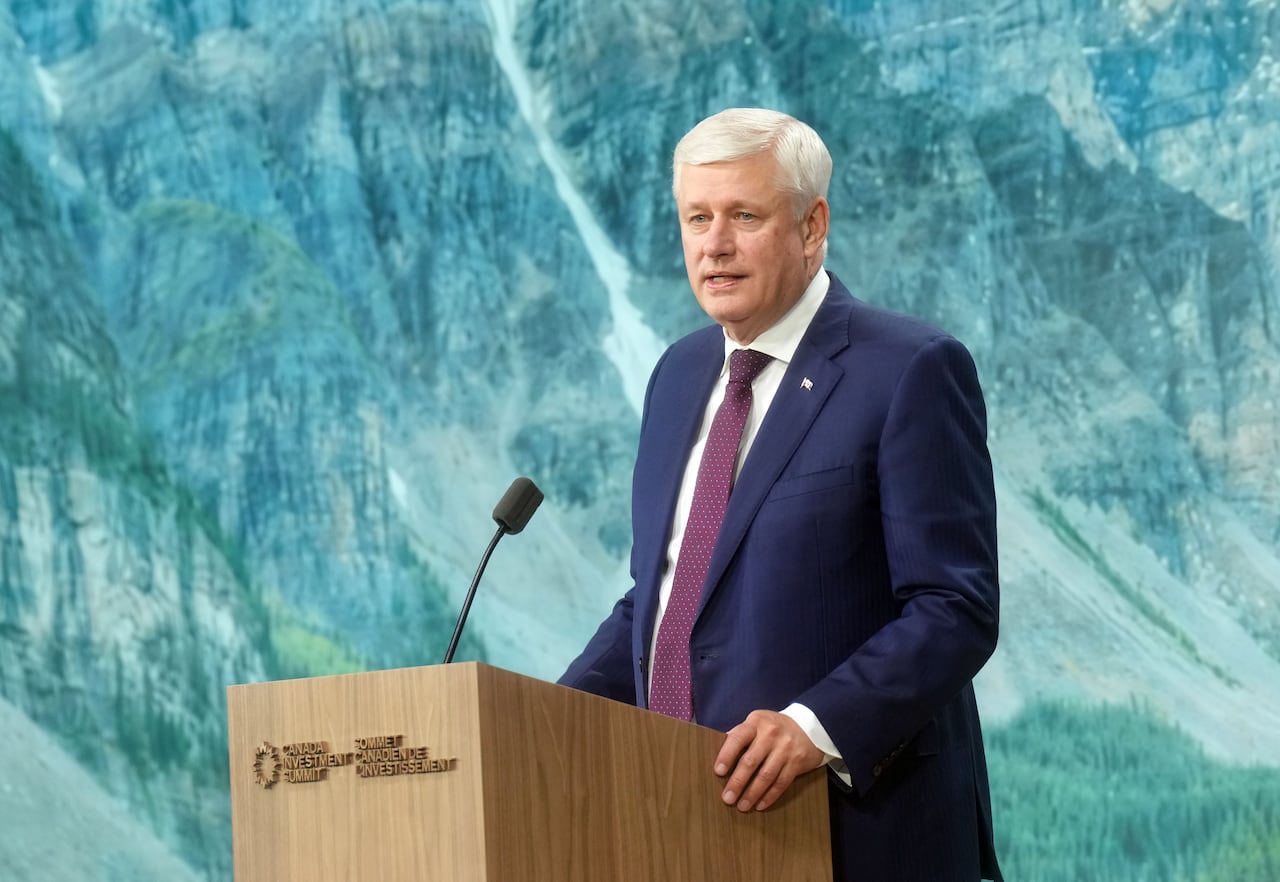
Stephen Harper, the last federal Conservative leader to form government, spoke at Prime Minister Mark Carney’s investment summit on Tuesday. (Nathan Denette/The Canadian Press)
When asked if the presence of the only modern Conservative prime minister at Carney’s event undermines his message, Poilievre asserted that “it does not,” adding that he had conversed with his party’s former leader just days prior.
“Certainly, Conservatives are always prepared to prioritize Canada, and we will collaborate with anyone,” he stated.
Yet, as other challenges arise for the movement, questions linger about who will support him.
Separation vote ahead
In British Columbia, the provincial Conservative Party has been losing MLAs, reminiscent of the federal MPs who have departed from Poilievre’s party over the past year.
Additionally, there is the upcoming referendum in Alberta next month, where voters will decide whether they want to remain part of Canada or potentially pursue a later vote on secession.
In contrast to Carney, Poilievre has already delivered two significant speeches in Alberta advocating for unity. However, unlike Carney, he must consider the party’s support base in the province. According to Coletto’s polling, nearly half of Conservative voters in Alberta express support for the separatist sentiment.
“If he aims to become prime minister of Canada, he cannot be perceived as a separatist,” Coletto stated.
Poilievre’s provincial counterpart, Alberta Premier Danielle Smith, may have experienced the consequences of a political party being perceived as too close to the sovereignty movement—securing a seat in a traditionally conservative Calgary riding for the Alberta NDP in a recent provincial byelection.
This adds yet another layer of difficulty for Poilievre’s coalition during a fall session where the agenda is already poised to overshadow his party.