
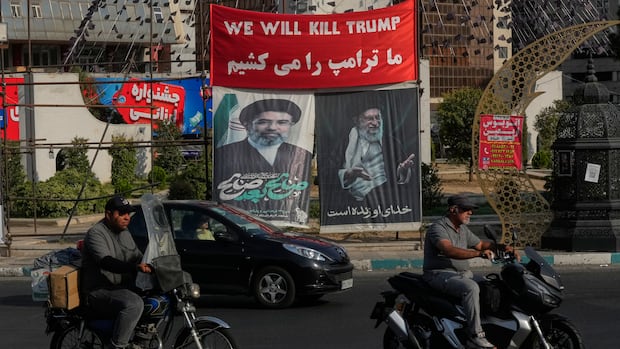

A senior advisor to Iran’s Islamic Revolutionary Guard Corps (IRGC) has remarked that Iranian officials have noted a perceived weakness in the American military since the U.S. and Israel initiated an attack on Iran earlier this year. The ongoing talks to resolve the conflict have hit a standstill.
Brig.-Gen. Mohammad Reza Naqdi, in a rare interview with Western media, conveyed to PBS News Hour that while Iran has not achieved its ultimate goal in the war, they consider themselves victorious up to this point and anticipate continued success in the future. Naqdi, serving as the supreme advisor to the commander-in-chief of IRGC, expressed these sentiments.
An initial agreement between Washington and Tehran to cease hostilities was reached in mid-June and is scheduled to expire shortly. Naqdi’s statements come following a breakdown of the ceasefire, leading to a series of exchanges between the U.S. and Iran before a temporary halt was implemented.
Naqdi emphasized the significance of the war in enhancing Iran’s combat experience, stating, “The longer this war lasts, the more experience we gain.” He highlighted that the five-month conflict has provided valuable insights into fighting against the American military, revealing perceived weaknesses.
President Donald Trump reiterated the U.S.’ control over the Strait of Hormuz, emphasizing the effectiveness of the naval blockade in a recent post on his social media platform, Truth Social.
Meanwhile, Pakistan has been actively engaged in efforts to revive negotiations between Iran and the U.S. Foreign Minister Ishaq Dar met with Iranian Ambassador Reza Amiri Moghadam in Islamabad, following Interior Minister Mohsin Naqvi’s visit to Tehran for talks with Iranian leaders.
Discussions have stalled primarily due to Iran’s control over the vital Strait of Hormuz, a critical route for global oil supply. The U.S. accuses Iran of failing to comply with the agreement to reopen the shipping route, while Iran asserts that the U.S. has not fulfilled its commitments, including lifting the blockade on Iranian ports and releasing frozen assets.
The conflict has resulted in numerous casualties, with Iran targeting U.S. assets and infrastructure in various countries. Both Iran and the U.S. have heightened their rhetoric in recent days, with Iran’s top security official stating that the Strait of Hormuz will remain closed unless the U.S. meets Iran’s conditions to end the war.
As the 60-day period outlined in the June interim ceasefire agreement approaches, both parties are expected to strive for a final deal that addresses Tehran’s nuclear program and U.S. sanctions, with the potential for an extension through mutual agreement.