
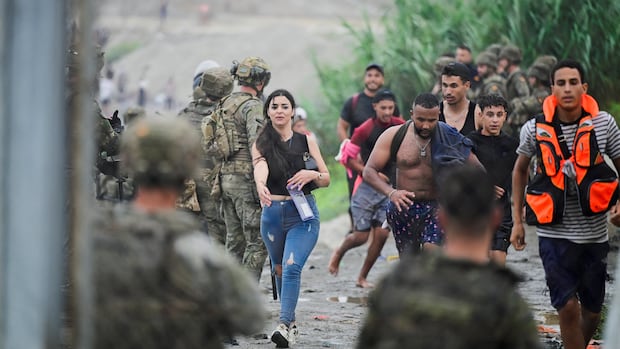

Spain and Morocco have bolstered the border fence of a Spanish enclave and seem to have effectively stopped mass crossings after a significant influx of people by sea and land in a single day. According to officials, at least 57 individuals have lost their lives after around 60,000 individuals entered Ceuta over the past few days. By 6 p.m. local time on Friday, an estimated 48,300 migrants had voluntarily returned to Morocco, as reported by Spain’s Interior Ministry.
The sudden surge of individuals crossing into Ceuta, a small Spanish-held peninsula protruding into the Mediterranean from Morocco, created shockwaves and division in Europe. Following this event, France announced increased border checks with Spain, while Italy threatened to suspend Spain from the European Union’s internal open border scheme.
Moroccan authorities at the gates of Ceuta utilized water cannon trucks to push back individuals and prevent further border crossings. They also resorted to using batons and tear gas to disperse the crowds. The aftermath of clashes included a bus and seven cars charred from the confrontations.
Despite a court ruling imposing restrictions on special “border rejection” rules allowing immediate expulsions from the enclave, Spanish authorities vowed to swiftly expel those who entered illegally. Prime Minister Pedro Sanchez condemned the mass crossings as a violation of Spain’s territorial sovereignty and called on Morocco to intensify efforts to stem the flow of people.
Ceuta and Melilla, another Spanish autonomous city in northern Morocco, boast the European Union’s sole land borders with Africa. These cities, each with a population of approximately 85,000, occasionally witness surges in attempted migrant crossings. However, the scale of Thursday’s influx was unprecedented.
Migration remains a contentious issue in Europe, particularly with the rise of right-wing parties. The French Interior Minister announced a fivefold increase in police presence on the Spanish border, coupled with enhanced aerial surveillance and train patrols. In response to the situation, German Chancellor Friedrich Merz expressed support for Spain’s stance against illegal migration.
President Donald Trump of the United States criticized the Ceuta crossings, likening them to an invasion and warning of similar scenarios in the U.S. if Republicans are not elected. Spain’s Socialist government, while maintaining firmness on illegal crossings, highlights the positive economic contribution of immigrants and recently offered a mass amnesty program resulting in a surge of citizenship applications.
As tensions escalate between countries over the migrant crisis, diplomatic exchanges have ensued, with Italy’s Foreign Minister criticizing Spain’s citizenship granting decisions, sparking a rebuttal from the Spanish Foreign Minister calling for solidarity rather than political rhetoric from partners.
The recent events in Ceuta underscore the complexities of migration and border control, prompting heightened security measures and political responses across Europe and beyond.