
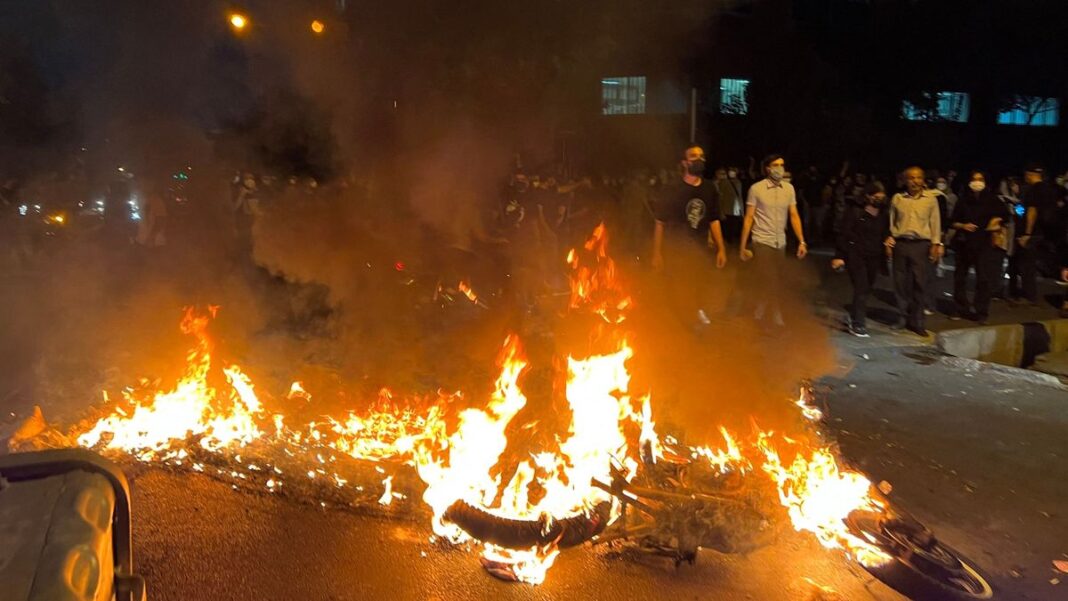

A warning from experts suggests that Britain and Western countries should distance themselves from Iran to allow for a potential popular and democratic uprising against the ruling Mullah regime that has held power since 1979. It is believed by senior Iranian dissidents that a growing rebel movement, consisting of around 20,000 covert cells, could lead to the downfall of the Islamic Republic of Iran and its enforcers, the Revolutionary Guard Corps. The dissidents estimate that a revolution might unfold in the coming months.
The rebel movement is said to be expanding weekly, with each secretive cell typically comprising more than 10 rebels. It is speculated that there could be up to 100,000 or even more members within these rebel units, who may even consider arming themselves if necessary. These cells operate independently, maintain secrecy, and are unaware of each other’s identities.
Dr. Majid Sadeghpour, an Iranian exile living in the United States and the political director of the Organisation of Iranian American Communities in Washington, highlighted the escalating pressure exerted by the regime on the Iranian populace. He underscored the regime’s intensified repression tactics in response to mounting political and military challenges.
The Supreme Leader of Iran, Ayatollah Ali Khamenei, currently wields ultimate authority over state affairs, the military, and the judiciary, succeeding Ayatollah Khomeini in 1989. The regime’s violent and repressive actions, including executions and torture, have been condemned by dissidents and activists both within and outside Iran.
Despite global concerns regarding Iran’s support for terrorism, nuclear ambitions, and involvement in regional conflicts, international policies have mainly focused on persuading Iran to alter its behavior rather than supporting a regime change. Dr. Sadeghpour emphasized the need for a coordinated uprising within Iran, highlighting the challenges posed by the regime’s brutal and unyielding nature.
Differing perspectives exist on the popularity and viability of the rebel groups within Iranian society. While some argue that the secretive units must have grassroots support to persist, others, like Professor Hamid Dabashi of Columbia University, suggest that there are no viable alternatives to replace the current regime, despite opposition to its rule.
The complex situation in Iran underscores the ongoing struggle between the regime’s repressive tactics and the aspirations of those seeking change. The potential for an armed uprising remains a topic of debate among experts and observers, reflecting the deep-rooted challenges facing Iran and its people.