
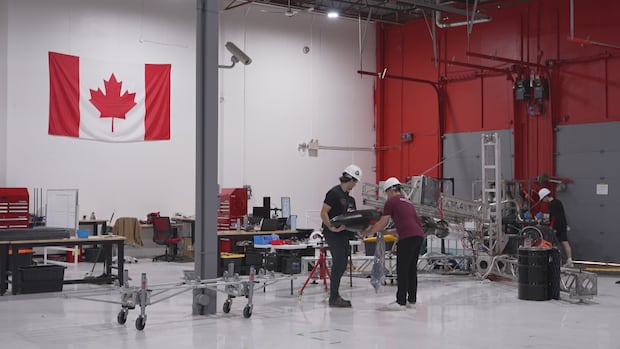

Canada, as the only G7 nation without its own rocket launch capabilities, is striving to establish a Canadian-made rocket. Several Canadian companies are in a race to provide the country with indigenous access to space, while concerns arise among some SpaceX clients about potential reduction in orbit rides. The journey to space for these rocket companies is complex, driven by substantial costs, strict timelines, and evolving government priorities.
Due to Canada’s lack of rocket launch capabilities, local customers, including private firms and government entities, rely on external providers to deploy their satellites into orbit, often turning to American companies like SpaceX. These satellites play crucial roles in various sectors such as telecommunications, military applications like threat detection, and earth observation like wildfire monitoring.
Marc Boucher, the founder of SpaceQ, emphasizes the significance of controlling Canada’s launches to prevent potential refusals by foreign entities to launch Canadian technology. The Canadian government recognizes space as a key sovereign capability, introducing legislation to enable launch authorizations from Canadian soil. Recent funding injections, including $8.3 million each for three Canadian rocket companies, aim to achieve light-lift rocket capabilities by 2028.
One of these companies, NordSpace, focuses on satellite and space technology development, with plans to test their suborbital rocket again after an unsuccessful attempt. Reaction Dynamics, another player, is working on an innovative engine design to achieve orbit-bound rockets by 2028. Canada Rocket Company, the latest entrant, aims to build a medium-lift rocket powered by methalox-fueled engines, with plans for a test facility in London, Ont.
While SpaceX plans to phase out its Falcon 9 rocket in favor of the Starship, concerns arise for its customers, especially smaller players reliant on rideshare programs. Canadian satellite communications company Kepler has launched most of its satellites on the Falcon 9, raising concerns about future access to space. Elon Musk’s transition plan could create opportunities for emerging rocket makers like Canada Rocket Company to fill the void left by Falcon 9.
Despite optimism within the industry, challenges remain as funding and testing are essential for successful rocket development. Both private and public investments are crucial for the Canadian rocket companies to meet ambitious timelines. The long-term nature of the space industry requires patience and perseverance, with expectations set on regular launches from Canada in the coming years.