
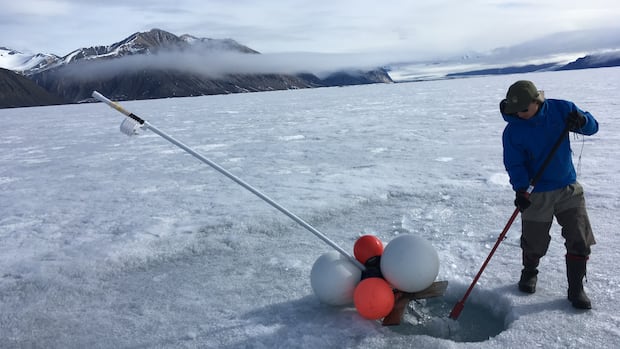

Canada’s sole remaining epishelf lake, characterized by freshwater floating above saltwater, has vanished, along with the distinctive ecosystem it sustained, as per scientists’ recent findings. Jérémie Bonneau, the principal investigator and an assistant professor at Laval University in Quebec City, expressed sorrow over the disappearance of the Milne Fiord epishelf lake on Ellesmere Island in Nunavut, emphasizing that it was the final of its kind in Canada. The abrupt drainage of the lake resulted in the loss of all life forms inhabiting it.
This event serves as a stark indication of how a warming climate is reshaping the Arctic, with the full extinction of this previously common phenomenon marking a significant shift and the conclusion of a 4000-year era. While the lake’s demise had been previously documented, a recent study published in Scientific Reports delves into the specifics of its disappearance, elucidating that the irreversible loss signifies a major environmental transformation.
The formation of epishelf lakes is an intriguing process. Glaciers, akin to ice rivers, typically flow into the ocean, carrying any surface meltwater along. In the case of the Milne Fiord, the mouth had been obstructed for millennia by the Milne Ice Shelf, creating a unique environment where freshwater accumulated atop the saltwater of the Arctic Ocean due to differing densities. Additionally, a protective layer of ice covered the lake year-round, shielding the freshwater and saltwater strata from wind-induced mixing and rendering the lake hidden from view.
Researchers discovered a distinct separation between the bacterial, viral, and phytoplankton communities residing in the lake’s two layers, with minimal overlap between the freshwater and saltwater ecosystems. This segregation created a rare scenario where two distinct ecosystems coexisted within the same water column. The lake’s microbial composition, including previously unreported Arctic species, revealed a rich diversity supported by this unique environment.
Tragically, the demise of the lake and its inhabitants was triggered by the 2020 collapse of the Milne Ice Shelf off the coast of Ellesmere Island, which released the lake from its confines. Following the collapse, the freshwater rapidly drained from the fiord, leading to the swift demise of the freshwater organisms upon mingling with seawater. The transformation of the once ice-covered freshwater lake into an ice-free saltwater fiord altered the marine environment, prompting a significant ecological shift.
With the extinction of epishelf lakes in Canada, similar ecosystems persist in Greenland and Antarctica, albeit facing an uncertain future. The loss of these unique habitats underscores the irreversible impact of climate change on these remarkable ecosystems, highlighting the urgent need for conservation efforts.