
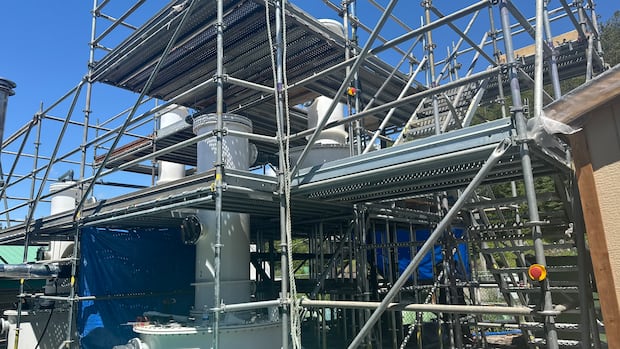

A startup in Nova Scotia is currently conducting trials on a technique to capture and store more carbon in the ocean. The company, pHathom, is exploring ways to enhance the ocean’s capacity to absorb carbon dioxide, a process it has been naturally doing for decades. By converting captured carbon dioxide into a safe form that can be stored in the ocean over long periods, pHathom aims to contribute to mitigating climate change.
The pilot project, taking place at the Huntsman Marine Science Centre in St. Andrews, N.B., is a crucial step in demonstrating the safety and effectiveness of the approach. Kimberly Gilbert, the CEO and co-founder of pHathom, emphasized the importance of proving the viability of local solutions in addressing global challenges like climate change. pHathom’s method involves replicating a natural process where rainwater absorbs carbon dioxide and interacts with alkaline rocks to convert the carbon dioxide into bicarbonate, which can then be stored in the ocean.
The startup’s innovative approach involves using a reactor to mimic this natural process by exposing seawater to carbon dioxide emissions from a biomass power plant. This interaction results in the conversion of carbon dioxide into bicarbonate, which is then reintroduced into the ocean. pHathom’s method boasts higher efficiency due to the concentrated carbon dioxide used in the process, allowing for accurate measurement of environmental impacts.
While pHathom is leading this initiative in Nova Scotia, other companies in the region are also exploring similar carbon removal methods, known as alkalinity enhancement. These companies, such as Planetary and CarbonRun, are experimenting with different techniques to increase the ocean’s capacity to absorb carbon dioxide.
The pilot phase of pHathom’s project aims to capture 0.1 tonnes of carbon dioxide daily, with plans to scale up operations in Nova Scotia next year. However, the scalability of such carbon removal technologies remains a challenge. Experts emphasize the need for significant advancements in these methods to achieve the necessary scale for effective global climate mitigation. Despite these challenges, the urgency of addressing the climate crisis underscores the importance of exploring and developing promising carbon removal technologies, alongside efforts to reduce emissions.
As the world grapples with the implications of climate change, initiatives like pHathom’s hold promise for contributing to a sustainable future. While challenges exist in scaling up these technologies, continued innovation and commitment to transitioning away from fossil fuels are essential in the fight against climate change. Ultimately, the success of these efforts will depend on collective action and global cooperation to address the pressing issue of climate change.