
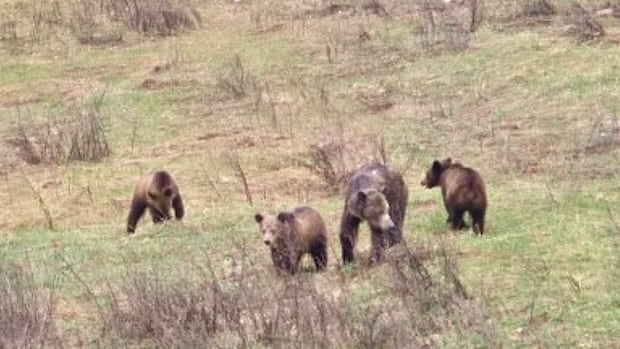

In an official announcement on August 14th, the B.C. Conservation Officer Service confirmed the euthanization of a mother grizzly due to public safety concerns stemming from the animal’s food-conditioned behavior and loss of fear toward humans. The two remaining yearlings were safely relocated to an undisclosed area for continued monitoring, as per the service.
A demonstration unfolded in Nelson, B.C., as a response to the decision made by the B.C. Conservation Officer Service to put down a young grizzly bear. The bear was a part of a renowned grizzly family often seen in and around Nelson, sparking widespread community interest.
Katie Graves, founder of the Ursa Project Society, described the emotional scene at the rally, emphasizing the unjust nature of the bear’s death. The yearling grizzly, with a leg injury or deformity, was deemed by Graves as capable and mobile, adapting to its condition while keeping up with its family.
Regarding the incident, the B.C. Conservation Officer Service stated that considering the bear’s age, injury, and history of conflicts, rehabilitation or relocation was deemed unfeasible. The service acknowledged the unfortunate necessity of euthanizing bears in such circumstances, emphasizing the weight of such decisions.
Graves highlighted the previous relocation and return of the mother bear with cubs in 2023, raising concerns about the fate of the other grizzlies, including a sow and two yearlings. The community’s response on social media platforms expressed disapproval of the bear’s killing, emphasizing the importance of better waste management to prevent such encounters.
Wildlife biologist Clayton Lamb stressed the need for stronger policies to reduce attractants and human-bear conflicts, urging proactive measures to prevent bear habituation in urban areas. Municipalities, including the City of Nelson, are actively implementing strategies such as bear-resistant garbage cans and educational programs to mitigate conflicts and ensure wildlife safety.