
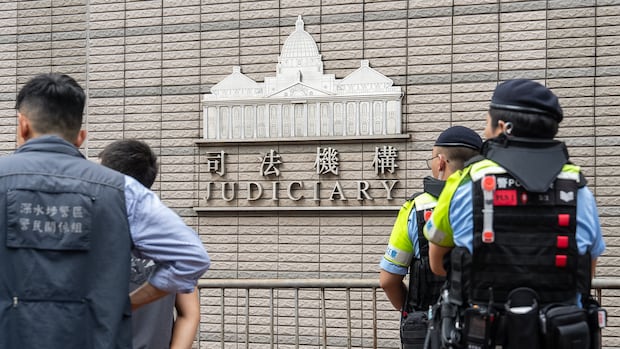

Two individuals who were previously involved in organizing Hong Kong’s annual vigil to commemorate the 1989 Tiananmen Square crackdown have been found guilty in a national security case related to a law imposed by China that has significantly impacted the city’s pro-democracy movement. Lee Cheuk-yan and Chow Hang-tung, former leaders of the Hong Kong Alliance in Support of Patriotic Democratic Movements of China, were convicted of inciting subversion under the national security law. Both had denied the charges and could face up to 10 years in prison. The alliance was also deemed culpable.
According to the verdict, the alliance’s advocacy to “end one-party dictatorship” was interpreted as aiming to overthrow and undermine the ruling Communist Party’s leadership, rather than calling for a return to a multiparty cooperation system as per the constitution. The judges highlighted that persisting with this call after the enactment of the law, despite its conflict with the constitution, constituted a violation under the security law.
This ruling is part of a series of legal actions against Hong Kong’s pro-democracy movement, which has been significantly weakened by authorities in both Hong Kong and China. For many years, the alliance’s candlelight vigil was a prominent public event that attracted thousands annually to honor those affected by the events in China. However, the vigil was prohibited in 2020 due to the COVID-19 pandemic and shortly before the implementation of the security law by Beijing to suppress the 2019 protests.
Lee and Chow, upon leaving the courtroom, acknowledged the public gallery with smiles and waves. Their sentencing is scheduled for a later date, where they are expected to appeal for reduced penalties. Observers view their trial as emblematic of the diminishing freedom of expression in Hong Kong since its handover to Chinese control in 1997.
The conviction of Lee and Chow has raised concerns among supporters who doubt the allegations against them. Despite the outcome being anticipated, Lee’s wife expressed disappointment and maintained his innocence, questioning the fairness of the judgment. The future possibility of an appeal is under consideration.
The aftermath of the ruling saw a significant presence of people outside the court, with some expressing disbelief at the potential implications for Hong Kong’s legal system. The Tiananmen Square crackdown of 1989, which resulted in numerous casualties, remains a critical point in China’s history, shaping its trajectory of economic reform without political liberalization.
Following the lifting of COVID-19 restrictions, the former site of the vigil in Hong Kong was repurposed for a carnival organized by pro-Beijing groups. The enactment of the 2020 security law was justified by Beijing as essential for the city’s stability, leading to the incarceration of key activists under this legislation, including media mogul Jimmy Lai. The political landscape has drastically shifted, resulting in the dissolution of numerous civil society organizations, including the alliance.