
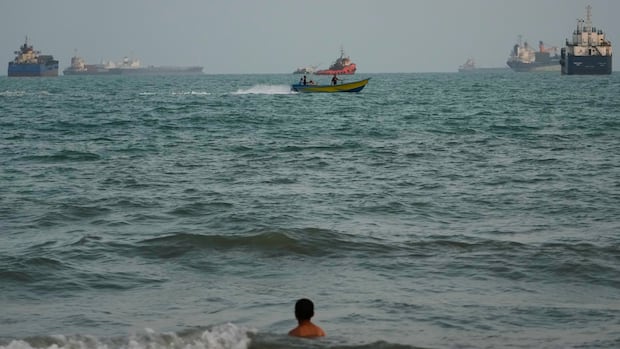

Iran’s new Supreme National Security Council leader announced plans for an “exclusion zone” outside the Strait of Hormuz to target vessels trying to pass through. The announcement lacked specific details and followed the U.S. retaliatory strikes on three Iranian oil tankers in response to Tehran’s ballistic missile launches towards American warships. Experts view these missile launches as a dangerous escalation, particularly after Iran’s previous assaults on commercial shipping.
The proposed exclusion zone will start from the U.S. naval blockade line, extend towards the Strait of Hormuz, and further into the Persian Gulf. Any identified ship entering this zone with the intention of transiting the strait will face sanctions, according to Mohsen Rezaei.
The exact location of the U.S. blockade, which aims to restrict Iranian port activities and oil shipments, remains unclear. The U.S. military disclosed that more than 20 warships are currently part of the blockade, redirecting 92 commercial vessels and disabling three as of Sunday.
Amidst the ongoing tensions, Iran claimed to have struck an unmanned U.S. vessel attempting to enter the Strait of Hormuz, a claim dismissed by the U.S. military as untrue. This incident follows a recent surge in hostilities between the two nations, with attacks and counterattacks escalating in the region.
The conflict, which originated from U.S. and Israeli strikes on Iran in February, has persisted despite intermittent ceasefires. The U.S. has been increasing pressure on Iran through military responses and economic measures, while Iran continues to navigate sanctions and maintain its oil exports through alternative means.
The strategic significance of the Strait of Hormuz, a critical route for global oil and gas shipments, remains a focal point of the conflict. Iran’s nuclear program, a catalyst for the war’s outbreak, has been a subject of failed negotiations between the U.S. and Iran, leading to heightened tensions and military confrontations.
According to U.S. Energy Secretary Chris Wright, approximately nine million barrels of oil pass through the strait daily, aiding in stabilizing energy prices. However, maintaining these flows relies on the U.S. navy’s presence to safeguard tanker transit, with expectations for other nations to support these efforts in the future.