
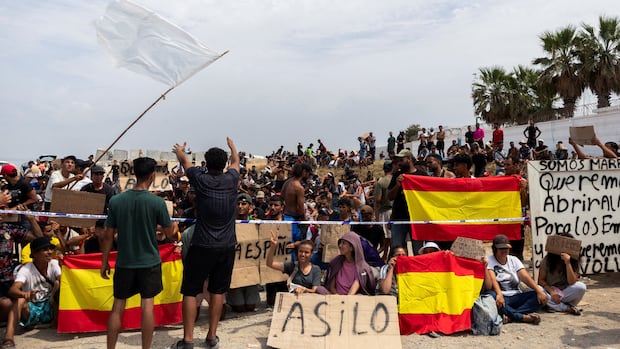

Hundreds of migrants who recently arrived in Ceuta, a North African enclave of Spain, gathered for a demonstration on a popular urban beach, appealing to Spanish authorities for asylum rather than being sent back to Morocco. These migrants are part of the 5,000 to 8,000 individuals who remain in Ceuta following a mass border crossing two weeks ago, during which over 72,000 people entered the small territory inhabited by approximately 80,000 residents. Most of the migrants are currently residing in challenging conditions on El Trampolin beach or the outskirts of the city as they await an opportunity to continue their journey to continental Europe.
Ayoub Elarroud, hailing from Tetouan, Morocco, expressed the hardships faced by the migrants, including sleeping near the sea in cold and unsanitary conditions, with restrictions imposed by the police preventing access to the city center. The protesters displayed Spanish flags and banners with messages such as “We don’t want to go back to Morocco” and “We are also human,” while voicing their exhaustion and the need for a solution.
In response to the influx of migrants, Interior Minister Fernando Grande-Marlaska stated that those who entered irregularly would not be permitted to stay in Ceuta, travel to mainland Spain, or acquire legal status, except in rare cases of extreme vulnerability. The healthcare services in Ceuta are strained, with Enrique Roviralta, head of Ceuta’s medical board, highlighting the exhaustion of limited healthcare workers and the emergence of diseases like infectious diarrhea and scabies, along with an increase in violence-related injuries.
Health Minister Monica Garcia emphasized that while local health services are under pressure, they have not collapsed, rejecting associations between migration and illness as unjust and xenophobic. Many of the Moroccan migrants revealed that they were driven by poor working conditions in their home country, despite holding higher qualifications. Mohammed Ouanzar, an automation specialist, cited low salaries as a barrier to buying a home or starting a family in Morocco.
The migrants shared their stories of hardship and determination, with individuals like Emmanuel from Nigeria undertaking perilous journeys to provide a better life for their families. Mohammad Ismail Hossain from Bangladesh recounted his challenging journey through multiple countries, while Ousmane from Senegal sought asylum due to persecution over his sexual orientation, expressing frustration over the waiting process for responses from local NGOs.