
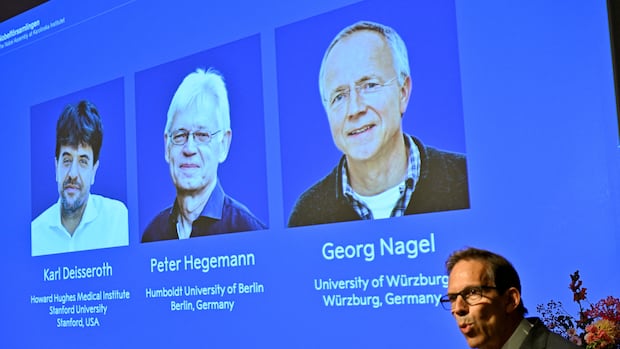

Karl Deisseroth, Peter Hegemann, and Georg Nagel have been awarded the 2026 Nobel Prize in Physiology or Medicine for their groundbreaking work on light-gated ion channels and optogenetics, as announced by the Nobel Assembly at Karolinska Institutet in Stockholm. Optogenetics, a technique developed by the laureates, allows for the precise control of individual nerve cell activity in the brain, unveiling new insights into brain functions globally.
The three esteemed scientists, Deisseroth from Stanford University, Hegemann from Humboldt University, and Nagel from the University of Würzburg, expressed their mutual appreciation for the recognition, emphasizing the collaborative nature of their work. They will divide the 12 million Swedish crowns prize money among themselves.
This innovative research has paved the way for revolutionary advancements in neuroscience, shedding light on how the brain processes information and facilitates interactions between different neurons. Clinical trials have shown promising results in restoring vision for individuals with retinitis pigmentosa through the insertion of light-sensitive proteins in the retina. Additionally, optogenetics holds potential for enhancing cochlear implants to deliver more precise stimulation to the auditory nerve compared to current methods.
The journey towards this groundbreaking discovery spans decades, starting with Hegemann’s investigations into light reactions in the alga Chlamydomonas in the early 1990s. Nagel’s experiments with Chlamydomonas genes led to the identification of channelrhodopsin-2, an ion channel responsive to light exposure. Deisseroth’s subsequent work in rat nerve cells in 2005 cemented the technique as optogenetics, showcasing its potential for cellular manipulation through light impulses.
The laureates’ collaborative spirit and shared dedication to scientific exploration have been instrumental in their success, marking a significant milestone in the field of neuroscience. The Nobel Prizes for chemistry and physics are set to be awarded in the following days, with literature, peace, and economics prizes to follow in the coming weeks, honoring individuals who have made exceptional contributions to humanity, as envisioned by Alfred Nobel, the founder of the prestigious awards.