
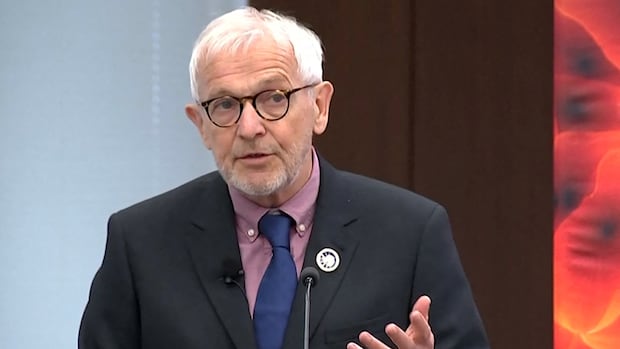

Belgian American physicist, Francis Halzen, aged 82, has been honored with the 2026 Nobel Prize in Physics in Stockholm. The prestigious award recognizes his pivotal role in the IceCube Neutrino Observatory and the groundbreaking discovery of high-energy neutrinos from astrophysical sources. Situated at the Amundsen–Scott South Pole Station in Antarctica, the observatory utilizes ice to track neutrinos, also known as “ghost particles” for their unique ability to traverse Earth and matter without leaving a trace.
Eva Olsson from the Royal Swedish Academy of Sciences described neutrinos as messengers from the universe, shedding light on distant galaxies and the phenomena of exploding stars. The Nobel Physics Prize, with a prize amounting to 12 million Swedish crowns ($1.7 million Cdn), is annually awarded by the Royal Swedish Academy of Sciences.
The IceCube Neutrino Observatory, covering a cubic kilometer, commenced operations in 2011, fulfilling a vision that originated in the late 1980s. Halzen expressed gratitude to his collaborators, acknowledging the initial skepticism surrounding the project’s success. Affiliated with the University of Wisconsin–Madison for several decades, Halzen expressed his delight and surprise at the announcement while attending a conference in Italy.
Neutrinos, minuscule cosmic particles with infinitesimal mass, emanate from celestial bodies like the sun, with trillions passing through our bodies every second. They remain elusive to direct observation, necessitating the measurement of their interactions with matter to decipher their properties. Halzen’s research on neutrinos offers valuable insights into the evolution of the universe, as highlighted by Mark Pearce, chair of the Nobel Committee for Physics.
The IceCube Neutrino Observatory, a multifunctional station accommodating up to 150 individuals, features amenities like an industrial kitchen, dining area, gym, and even a greenhouse. Plans for an extension – IceCube-Gen2, covering eight cubic kilometers of ice – aim to enhance neutrino detection capabilities significantly by 2033.
Halzen emphasized that the full implications of his work are yet to be unveiled, emphasizing the ongoing exploration of astronomy. Belgian Prime Minister Bart De Wever commended Halzen for his dedication to unraveling cosmic enigmas through neutrino research. The Swedish academy had previously recognized the discovery of neutrino oscillations in 2015, with Canadian scientist Dr. Arthur McDonald sharing the Nobel Physics Prize that year.
The Nobel Prize, established by Alfred Nobel, a Swedish chemist and entrepreneur, is awarded annually to individuals who have made significant contributions benefiting humanity. The laureates will be presented with their prizes on December 10, commemorating Nobel’s death anniversary.