
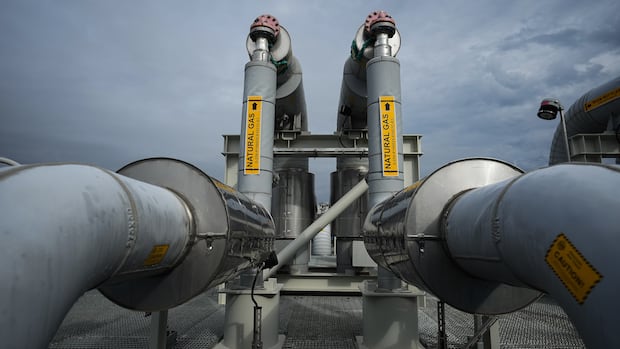

Prime Minister Mark Carney emphasized the crucial role of Canadian natural gas exports in driving American economic growth in a recent speech. This raises the question of the potential impact if Canada were to cease sending natural gas south of the border.
Despite the ongoing Canada-U.S. trade tensions, energy products like oil and natural gas have not been used as bargaining tools. The discussion around using energy exports as leverage has stirred debate, with Alberta Premier Danielle Smith opposing the idea while Ontario’s Doug Ford advocates for exploring all options.
Carney highlighted that the U.S. heavily relies on Canada for energy, stating that Canada supplies 99% of their natural gas imports, 85% of their electricity imports, and 60% of their crude oil imports. While the U.S. imports a significant amount of natural gas from Canada, it represents only a small portion of their overall consumption, as per the U.S. Energy Information Administration.
Dulles Wang, from energy research firm Wood Mackenzie, estimated that Canadian natural gas supplies account for about five to eight percent of the U.S. consumption. The interconnected natural gas pipelines between Canada and the U.S. play a vital role in meeting the energy needs of both nations.
Enbridge, headquartered in Calgary, stands as the largest natural gas provider in North America. The company’s strategic acquisitions in the U.S. energy sector further solidify its position in the market. Wang emphasized the importance of the bi-directional flow of natural gas between the two countries, with the U.S. not only importing from Canada but also exporting gas back to Canadian markets.
While the volume of Canadian natural gas shipments to the U.S. may be relatively small in comparison to domestic production, the geographical distribution of these deliveries is significant. Regions like the Pacific Northwest heavily rely on Canadian natural gas imports, with over 90% of the gas supply coming from Canada.
The increasing demand for energy, driven by technological advancements like artificial intelligence, has led to the rise of data center construction in regions supplied by Canadian natural gas. The reliance on natural gas for these energy-intensive facilities underscores the importance of uninterrupted energy supply.
Halting natural gas exports to the U.S. would have severe repercussions for the Canadian energy industry, leading to an oversupply situation and plummeting prices. This move would not benefit either country, as it would disrupt the energy market dynamics and negatively impact both economies.
To diversify its energy export markets, Canada is exploring opportunities to export liquefied natural gas to Asian markets. Initiatives like the LNG Canada facility in Kitimat, B.C., signify Canada’s efforts to reduce dependency on the U.S. market and expand its global energy footprint.