
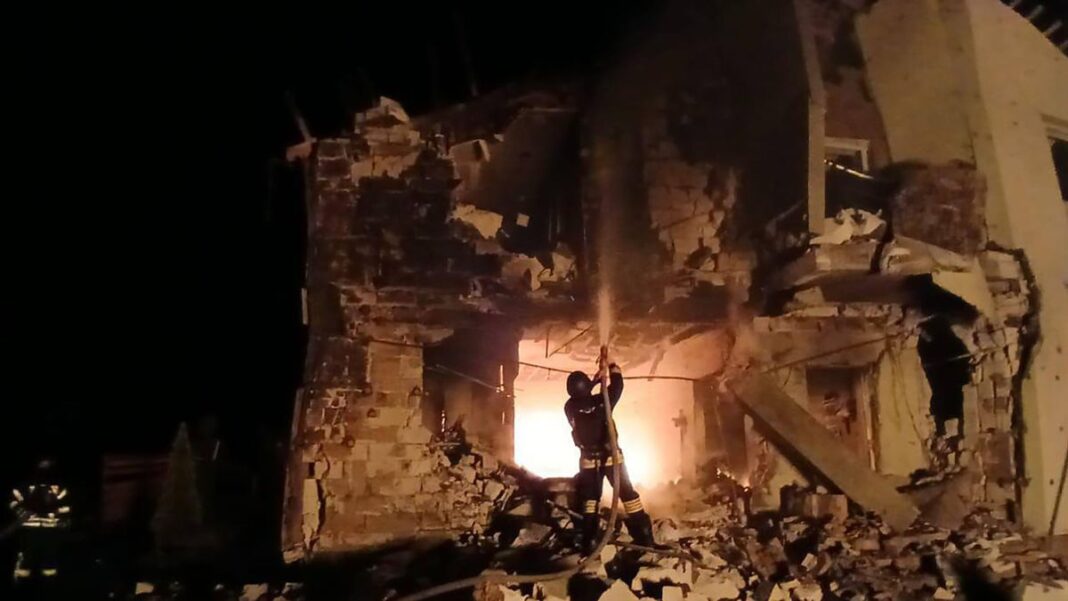

Poland and fellow NATO members swiftly launched fighter jets in response to a significant attack on Ukraine orchestrated by Vladimir Putin, involving over 650 drones and 50 missiles. The assault led to extensive damage and widespread power outages in Ukraine.
In a state of high alert, Poland’s military deployed fighter jets and an early warning aircraft to bolster ground-based air defense and radar systems in Warsaw. The strikes by Russian forces resulted in the deaths of three individuals, including a young girl, and left 17 others severely injured, including six children, as reported by authorities in Kyiv.
The assault caused countrywide power disruptions, with Ukrainian Prime Minister Yulia Svyrydenko suggesting that the intention was to cause chaos and hinder residents’ ability to keep warm during the approaching winter months.
Near Ukraine’s border with Poland, neighboring Western communities also faced attacks, prompting Polish warplanes to take precautionary measures in case any missiles strayed across the border.
Poland’s operational command confirmed the heightened activity, stating that Polish and allied air forces were operating in the country’s airspace as a response to the Russian attack on Ukrainian targets. Fighter pairs, an early warning aircraft, and ground-based air defense systems were placed on high alert.
The escalation by Russia involved various military assets, including air-launched missiles and drones, causing widespread disruptions and damage in Ukraine. Ukrainian President Volodymyr Zelensky acknowledged the severity of the air strikes, noting both successful interceptions and unfortunate hits.
Throughout different regions in Ukraine, including Zaporizhzhia, Dnipro, and Ivano-Frankivsk, sustained attacks led to destruction, power outages, and disruptions to critical infrastructure. The assaults even targeted areas further west of the frontline, demonstrating the extent of the aggression.
The Burshtyn Thermal Power Plant, a vital energy junction connecting Ukraine with neighboring countries, faced repeated damage during the conflict but is expected to be restored once again. In regions like Mykolaiv and Lviv, power outages and disruptions to services were reported due to the attacks.
Discussing the response from Poland and NATO, Polish Minister of Defence Władysław Kosiniak-Kamysz highlighted the challenging circumstances and the need for continuous vigilance. The alliance’s actions were intensified following previous airspace violations, signaling a united front against threats to territorial security.
Russian Kremlin spokesman Dmitry Peskov’s comments in mid-September suggested a narrative of NATO’s involvement in conflict with Russia through support for Ukraine, further escalating tensions between the parties.