
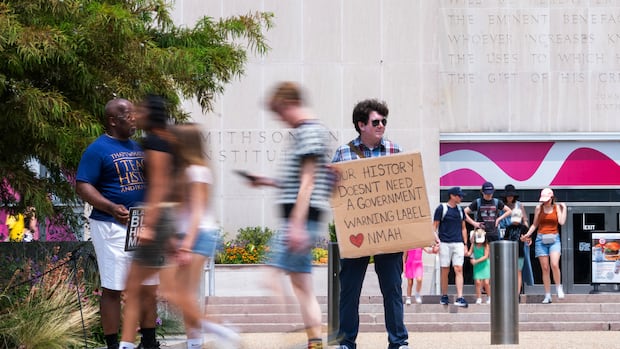

The Smithsonian’s National Museum of American History in Washington, D.C. attracts Americans and global visitors daily to view iconic artifacts like Dorothy’s ruby slippers from the Wizard of Oz, inaugural gowns of U.S. first ladies, and the Star-Spangled Banner flag. Recently, the museum has drawn attention due to protests outside its doors, with demonstrators holding signs advocating for truth and criticizing historical narratives dominated by rich, elderly white men.
The Trump administration’s current actions are viewed as part of a broader strategy to influence the storytelling of America as presented by cultural institutions. Observers believe these efforts align with a longstanding conservative agenda to shape exhibits and programs according to conservative values. Additionally, there is an apparent push to diminish the influence of independent experts in areas where the administration seeks more control.
President Trump’s directive in July called for warning signs at the museum cautioning visitors about potential inaccuracies within the exhibits. Although the signs are not yet displayed, they are expected to refer visitors to a 162-page White House report released on America’s 250th anniversary, primarily focusing on the National Museum of American History. The report accuses Smithsonian leadership of extreme political activism and prioritizing narratives of shame and division over celebratory and patriotic stories.
In response to these challenges, the Smithsonian has defended its autonomy vigorously. Anthea Hartig, the museum’s director, faced intense questioning from Republicans in late July during a House oversight committee hearing. Despite the scrutiny, she affirmed her unconditional love for America. The Smithsonian Secretary, Lonnie Bunch, emphasized the institution’s commitment to accuracy and presenting a comprehensive portrayal of America’s history, countering claims of bias.
The recent events, including the White House report, committee hearings, and the directive for warning signs, suggest a concerted effort by the administration to influence Smithsonian operations. Concerns linger about potential future attempts to alter the museum’s leadership composition to align with political objectives. Critics fear these actions could reflect personal agendas rather than genuine historical preservation efforts.
The Smithsonian, a renowned institution with nearly two centuries of history, remains a trusted entity among Americans. Despite challenges to its independence, public opinion favors curatorial autonomy within the Smithsonian, transcending political affiliations. Surveys indicate that a majority of conservatives and liberals oppose external pressures to censor museum content, highlighting a shared commitment to preserving diverse historical perspectives.
Visitors to the National Museum of American History offer varying perspectives on the exhibits. While some criticize perceived leftist inclinations in the museum’s narrative, others appreciate the representation of diverse American experiences, acknowledging the complexity of the nation’s history. The museum serves as a platform for self-directed educational experiences, showcasing both the triumphs and tribulations of American history.