
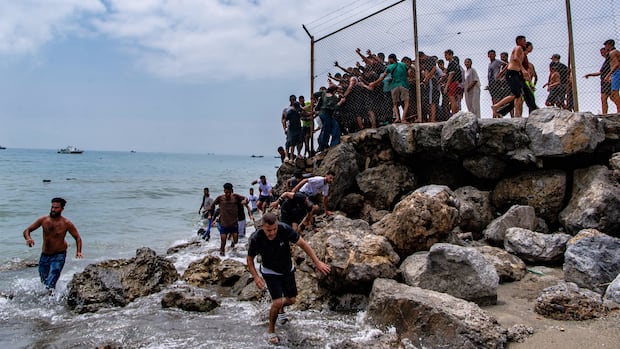

Spanish authorities have characterized the situation as “complete disorder,” “unsustainable,” and “a breach.” A minimum of 57 individuals have lost their lives following the incursion of tens of thousands of migrants across the Moroccan border into Spain’s Ceuta enclave via both land and sea, creating astonishment and discord across Europe.
Approximately 60,000 people are estimated to have entered the Spanish enclave in North Africa on Thursday, with around 48,300 individuals returning to Morocco by Friday evening. Many migrants arrived by sea, swimming about five kilometers from the Moroccan town of Fnideq, while others attempted to cross from the nearby town of Belyounech, which is a shorter distance.
Some of the migrants who made the crossing were observed to be children and unaccompanied minors, prompting concerns from a Moroccan NGO about the risks involved in taking children on irregular migration journeys.
Spanish authorities confirmed the recovery of 57 bodies on the Spanish side of the border, with the possibility of additional casualties on the Moroccan side. The fatalities included individuals who drowned or were crushed while attempting to scale the breakwater that supports the border fence.
The city of Ceuta, an 18.5-square-kilometer peninsula with a population of approximately 83,000 people, experienced a surge of 73% in its population when 60,000 migrants crossed the border in a single day. Ceuta, in Spanish possession since 1580, hosts a diverse population of Christians, Muslims, and both Spanish and Moroccan residents.
Spain is a key entry point into Europe for migrants seeking improved economic prospects or fleeing violence in their home countries. Ceuta and Melilla are heavily fortified territories often targeted by migrants attempting to reach Spain from Morocco and other African regions. The recent rush was linked to a Spanish Supreme Court ruling that differentiated between migrants arriving by sea and those crossing by land or climbing the border fence.
The surge at the border, although sudden, was a culmination of long-standing factors. In Morocco, discontent over poor public services and widespread poverty has led many young people to seek better opportunities by crossing the border into Ceuta and Melilla. The calm seas at this time of year facilitated the sea crossings for migrants.
In response to the situation, Spain deployed its armed forces and additional police to restore order in Ceuta. Spanish authorities indicated their intention to swiftly expel those who entered illegally. On the Moroccan side, security forces used batons and tear gas to deter more migrants from crossing into Ceuta and Melilla. By Friday afternoon, most migrants were attempting to leave Ceuta.
Several migrants who returned to Morocco cited a lack of food and shelter in Ceuta as reasons for their departure. Some reported enduring days without water and having to sleep outdoors. Despite the return of some migrants, others continued their attempts to enter Ceuta by swimming around the breakwater.
The events in Ceuta have underscored the complex dynamics and challenges surrounding migration in the Mediterranean region.