
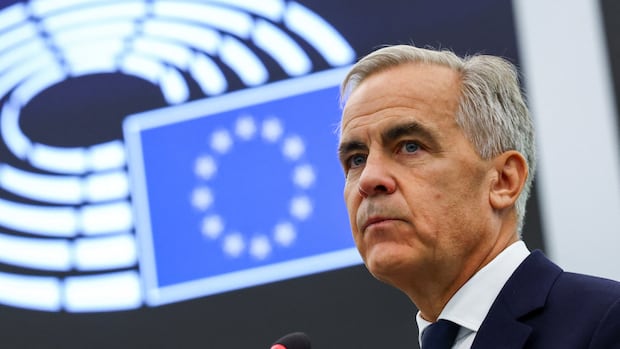

Prime Minister Mark Carney responded to U.S. President Donald Trump’s recent remarks regarding Canada’s pursuit of a closer relationship with the European Union, which Trump deemed “laughable.”
During a press conference on Thursday, Carney stated that a partnership with the EU would enhance Canada’s role as a “better partner” to the U.S., while emphasizing the need for Canadian independence to be acknowledged within the U.S. relationship.
“We aim for partnerships that are complementary and reinforce our sovereignty,” Carney remarked in response to Trump’s statements.
“Canadians are unified in that no one will dictate our language, culture, or the international agreements we pursue,” he added.
Carney made these comments following his address to the European Parliament in Strasbourg, France, as he seeks to strengthen ties with Europe amidst the ongoing trade tensions with the United States.
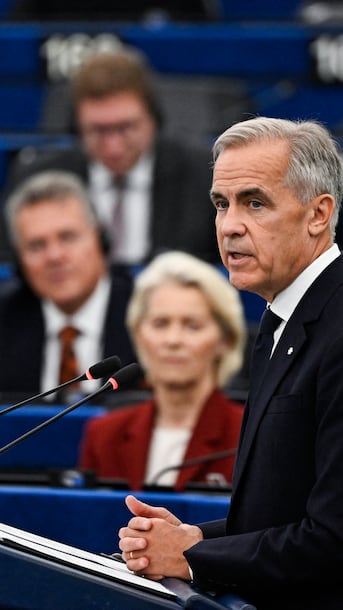
While the prime minister did not mention Trump directly, he referenced the U.S. leader’s strategies during his speech. Carney reiterated points from his earlier speech at Davos, noting that economic integration is often utilized as leverage, implying that Europe could serve as a more dependable ally.
“We are not fair-weather allies. We do not engage in zero-sum negotiations,” Carney stated. “We share common values for which we have consistently fought and must remain vigilant in defending.”
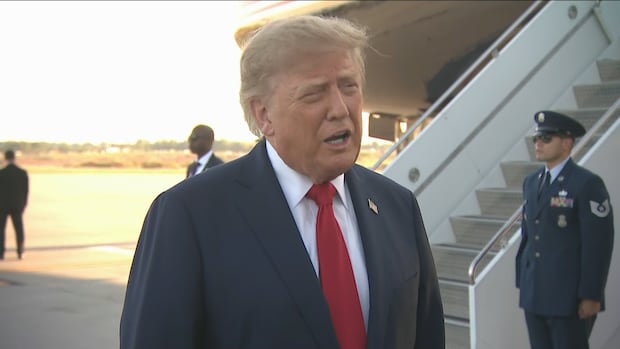
When questioned about Canada and the EU’s efforts to enhance their partnership, Trump dismissed the notion as “laughable” and warned the EU of potential “very serious tariffs” if it pursues a trade deal with Canada “with bad intentions.”
As Carney prepared to speak, Siegbert Droese, a German politician from the far-right Alternative for Germany, shouted “U.S.A., U.S.A.!” to which Carney laughed while some attendees booed.
Droese later explained to CBC News that his outburst aimed to “address the geopolitical elephant in the room,” asserting that the U.S. remains Europe’s most vital trading partner.
“It was an absurd and unrealistic knee-jerk reaction for Ms. von der Leyen to suggest an ‘associate EU membership’ for Canada, a status that doesn’t exist in any European treaties,” he remarked. “I hold affection for both the American and Canadian people.”
Carney advocated for an “alliance of the future” between Canada and the 27 EU member states.
“Together, Canada and the EU can solidify our foundation to uphold our values while creating a protective framework for our citizens to flourish,” he stated.
“This is fundamentally about sovereignty. It pertains to our right to live as we choose. It is about the freedoms we must champion daily. Sovereignty demands resilience—the capacity to endure challenges.”
-
What we know about the proposed partnership between Canada and the EU
-
Q&A
Canada is ‘the most European of non-European countries,’ says Stéphane Dion
In his address, Carney criticized Trump and other dominant powers, asserting that a Canada-EU alliance could serve as a “beacon for other democracies.”
“I want to clarify what I am not suggesting. I am not advocating for the creation of a third bloc aimed at becoming a great-power competitor with better manners,” he said.
“We do not seek power to subjugate others. Instead, we pursue resilience to ensure that no one can manipulate our open markets, compromise our sovereignty, threaten our territorial integrity, or undermine our freedoms, our democracies, or our rule of law.”
Over the past year, Canada has entered into several new agreements with the EU, and it has also become the first non-European nation to join Security Action for Europe (SAFE), which allocates €150 billion in loans for defense initiatives.
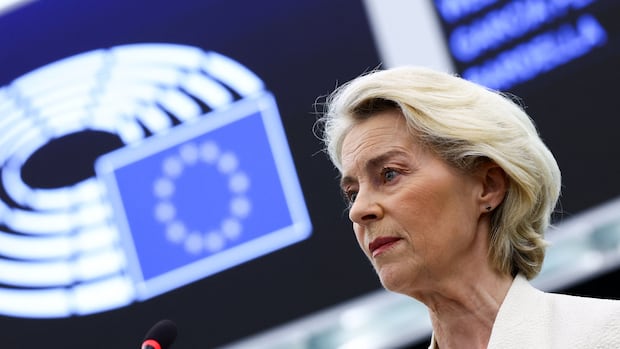
European Commission President Ursula von der Leyen emphasized the potential of the Canada-Europe relationship in her state of the European Union address, stating, ‘This is not a partnership against anyone else, but for our common strength.’
Fostering people-to-people connections
Carney proposed that Canada participate in Erasmus+, the EU’s program that supports education, training, youth, and sports initiatives. He also suggested that Canada could broaden its involvement in Horizon Europe, the EU’s funding program for research and innovation projects, which has a budget of approximately $150 billion for 2021-2027.
“We should strengthen our people-to-people connections, enabling our youth to live, work, and study wherever they choose across the Atlantic,” he expressed.
This speech follows European Commission President Ursula von der Leyen’s announcement on Wednesday that the EU is open to the idea of Canada becoming an “associate member” of the bloc.
“I am eager to collaborate with you to pave the way for Canada to become the first associate member of the EU,” von der Leyen stated, receiving a standing ovation.
- What questions do you have about the proposed partnership between Canada and the EU? Send them to ask@cbc.ca.
After her remarks, Carney acknowledged von der Leyen, standing up to approach and embrace her, before waving to the assembly and returning to his seat.
The EU leader stressed the necessity of “urgently reimagining” the partnership and moving beyond a mere free trade agreement.
Carney expressed his support for this ambitious vision but chose to refer to it as an “alliance for the future.”
“Canada and Europe must secure our strategic autonomy through extensive cooperation across all strategic capabilities,” he stated.
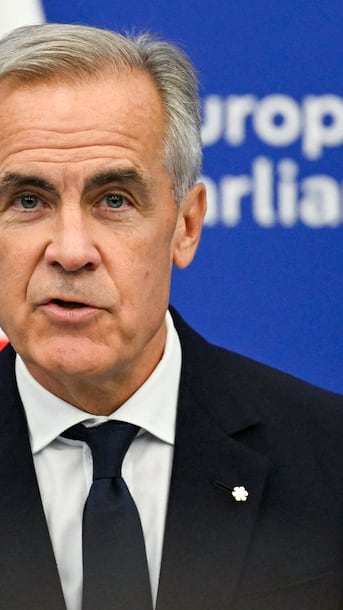
Prime Minister Mark Carney announces that Parliament will debate and vote on the structure of an alliance with the European Union, aiming to strengthen Canada’s sovereignty and sustainability.
Focusing on substance over labels: Carney
Carney and his administration have been de-emphasizing the term “associate member” to characterize the new partnership since it was introduced in a report by the Wall Street Journal last week, which cited unnamed sources.
When asked about the concept of Canada becoming an “associate member,” Carney stated that the “substance” of the agreement is far more significant than its label.
The prime minister clarified that Canada is not aspiring to be a full EU member and that the ultimate agreement regarding the alliance will be subject to debate and a vote in Canada’s Parliament.
Jonathan Wilkinson, Canada’s incoming ambassador to the EU, reiterated on Wednesday that Canada is not seeking full EU membership in light of von der Leyen’s address.
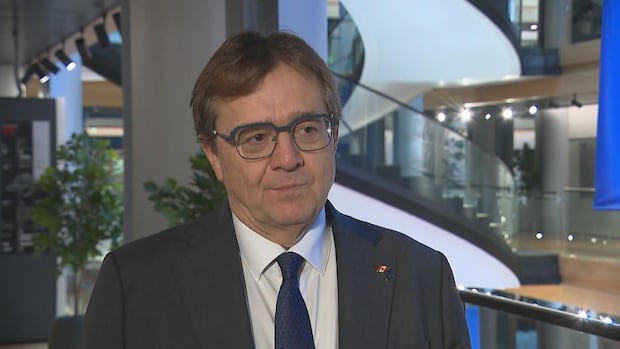
Jonathan Wilkinson, Canada’s new ambassador to the European Union, emphasizes that ‘we’re not there yet’ regarding the potential for associate membership, focusing instead on achieving tangible results.
“There are various ways people have described what this [new relationship] could entail. We need to reach a point where we clearly define what we are describing,” Wilkinson told reporters after von der Leyen’s address.
“It’s about terminology; ultimately, there are multiple ways to characterize it.”
Carney met with von der Leyen on Wednesday, where they discussed sectors in which both leaders believe they can enhance collaboration, including critical minerals, AI, defense, energy, and finance.