
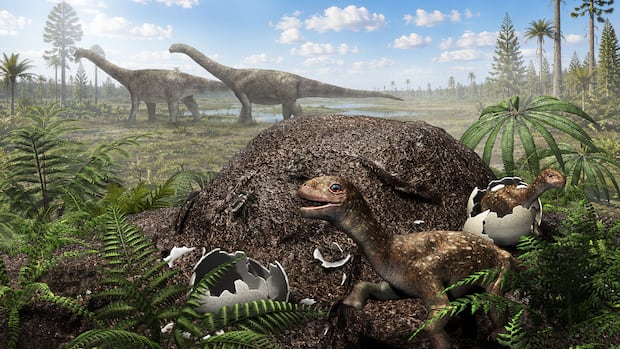

Fossilized eggshells believed to belong to some of the largest dinosaurs ever discovered have been unearthed in a surprisingly cool region far from the equator. Despite their enormous size, these titanosaurs could not rely on brooding to keep their volleyball-sized eggs warm.
A recent study led by University of Calgary paleontologist Darla Zelenitsky and researchers from Japan and Argentina delved into the microscopic details of the eggshells to unravel how the titanosaurs managed to maintain the necessary warmth for the eggs to hatch successfully. Their findings suggest that titanosaurs likely employed a method akin to that of modern crocodiles by burying their eggs in warm, decaying vegetation piles.
Titanosaurs, colossal herbivorous dinosaurs characterized by their long necks and tails, weighed up to 75 tonnes and roamed on four legs. Volleyball-sized fossil eggs associated with titanosaurs, known as Fusioolithus, were previously discovered in warmer climates. However, recent findings in the Chorrillo Formation at the southern tip of Argentina unveiled fragments of Fusioolithus eggshells dating back to the Late Cretaceous period, around 72 to 66 million years ago.
Despite the distance from the equator, the Chorrillo Formation, formerly located at a latitude similar to Red Deer, Alta., boasted a climate resembling that of present-day New York City. The region supported a diverse ecosystem including titanosaurs like Nullotitan glaciaris, smaller herbivores, formidable predators, and various other flora and fauna.
To ensure successful incubation of their eggs, dinosaurs needed to keep them warm for extended periods. While smaller dinosaurs could brood their eggs, titanosaurs had to explore alternative methods to avoid crushing their eggs. The researchers found that titanosaur eggshells from the Chorrillo Formation were highly porous, indicating burial as a means of incubation.
The study sheds light on the remarkable adaptability of dinosaurs, showcasing how even the largest species found innovative ways to reproduce and survive in diverse environments. The discovery challenges previous notions about dinosaur nesting behaviors and highlights the importance of further research to unveil the complexities of prehistoric life.