
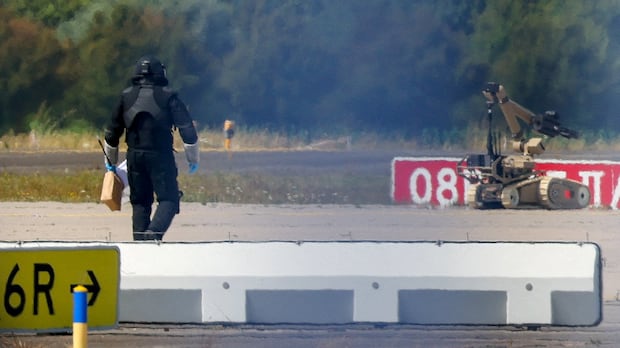

German authorities are currently investigating a drone equipped with explosives and a detonator discovered at Leipzig airport. In response, Russian Foreign Minister Sergey Lavrov has indicated Moscow’s intentions to escalate retaliatory actions against countries aiding Ukraine.
Lavrov stated in an interview with VGTRK, Russia’s state media, “We will employ more severe measures to dismantle all support for Kyiv’s military capabilities from the West. We are already taking steps in this direction.”
The drone, carrying an unidentified explosive device, was found by an airport employee in the cargo operations zone’s security area near Leipzig airport’s south runway. Leipzig serves as a crucial NATO airport for transporting arms, ammunition, weapons, and other military supplies to Ukraine via flights operated by Ukrainian cargo firms.
The presence of the drone next to one of the Ukrainian cargo planes represents a heightened threat level for Germany, as noted by the country’s interior minister, Alexander Dobrindt. He emphasized that the incident is being treated as part of a sophisticated hybrid threat scenario rather than an amateur undertaking.
While German authorities are conducting a thorough investigation, they have not disclosed the origin of the drone. However, recent U.S. intelligence reports suggested potential links between the drone and the Russian government.
Notably, Germany is enhancing its anti-drone capabilities cautiously without prematurely assigning blame. Dobrindt emphasized the ongoing fact-finding process and refrained from making premature statements on the matter.
Concerns are rising about Russia’s utilization of drones, espionage, sabotage, and influence operations across Europe, particularly in the lead-up to upcoming regional elections in Germany. Dobrindt warned of the evolving threat landscape faced by Germany and the daily hybrid warfare targeted at the country.
Reflecting on past incidents, including a foiled plot to assassinate a German defense contractor CEO and the arrest of a suspected Russian spy gathering intelligence on military support for Ukraine, Germany remains vigilant against foreign interference. The Institute for Strategic Dialogue highlighted Russia’s online interference campaign, Operation Overload, aimed at sowing discord within NATO member countries and Ukraine, notably targeting Germany, France, and Ukraine.
As Germany grapples with these complex challenges, Lavrov’s statements signal a departure from Russia’s previous denials of involvement in hybrid warfare operations targeting Western nations. This shift indicates a more aggressive stance towards Europe, the West, and NATO, according to Hans-Jakob Schindler of the Counter Extremism Project. Schindler raised critical questions about defining the boundary between defense and direct conflict in the face of escalating physical threats posed by Russia.