

On the morning of Monday, March 2, a rider using Edmonton’s transit system was attacked while making their way through Churchill Station to access the Valley Line LRT.
“They hit me in the face,” the rider conveyed in a text sent later that day to Transit Watch, the safety reporting line for Edmonton Transit Services.
“I didn’t report it right away because I just wanted to leave and go home,” the rider explained in the message.
On the same day, Transit Watch received multiple reports from riders detailing incidents of harassment, open drug use, drug dealing, a fire being started at a bus stop, and someone brandishing a lighter inside a transit center.
The City of Edmonton has been working for several years to enhance safety on public transit, increasing the number of peace and police officers, expanding outreach teams, and investing more in cleaning and security upgrades.
Nevertheless, text messages sent to the service over the course of one month earlier this year indicate that numerous riders continue to have concerns about safety within the system.
CBC News acquired text communications submitted to the line between mid-February and mid-March through a request under the Access to Information Act. The documents, which totaled over 200 pages, include incoming reports and responses from control center staff, revealing daily reports from various parts of the city.
Drug use remains a primary issue
Many reports highlight worries regarding drug use and smoking occurring in LRT stations, bus stops, and pedways.
“It would be wonderful to make my commute without being exposed to illegal drugs and dangerously unstable addicts EVERY day,” one rider texted in February while reporting drug use in an LRT shelter at the Kingsway/Royal Alex LRT station.
Riders reported witnessing individuals using meth, crack, and fentanyl on transit properties. One individual described being verbally assaulted for ten minutes on a bus by a person under the influence of drugs. Another mentioned that a female passenger, high on drugs, directed antisemitic slurs and hateful remarks towards them for several minutes without any provocation.
“I would really like to go in and warm up at Kingsway Station, but there are people smoking numerous pipes in there, and I don’t feel comfortable inhaling that,” one rider wrote on February 21.
Transit users also reported observing drug transactions, discovering drug paraphernalia, and encountering individuals urinating, yelling, and obstructing pathways.
One texter recounted reaching for a ticket machine at Davies Transit Centre and finding a used condom inside.
“I wanted to report this because it poses a safety risk if someone reaches in there without checking,” the individual wrote.
Other messages mentioned finding a pool of blood inside the Belvedere Transit Station, fires set in transit areas, broken glass, a person being pushed on an LRT train, and threats of stabbing at MacEwan LRT station.
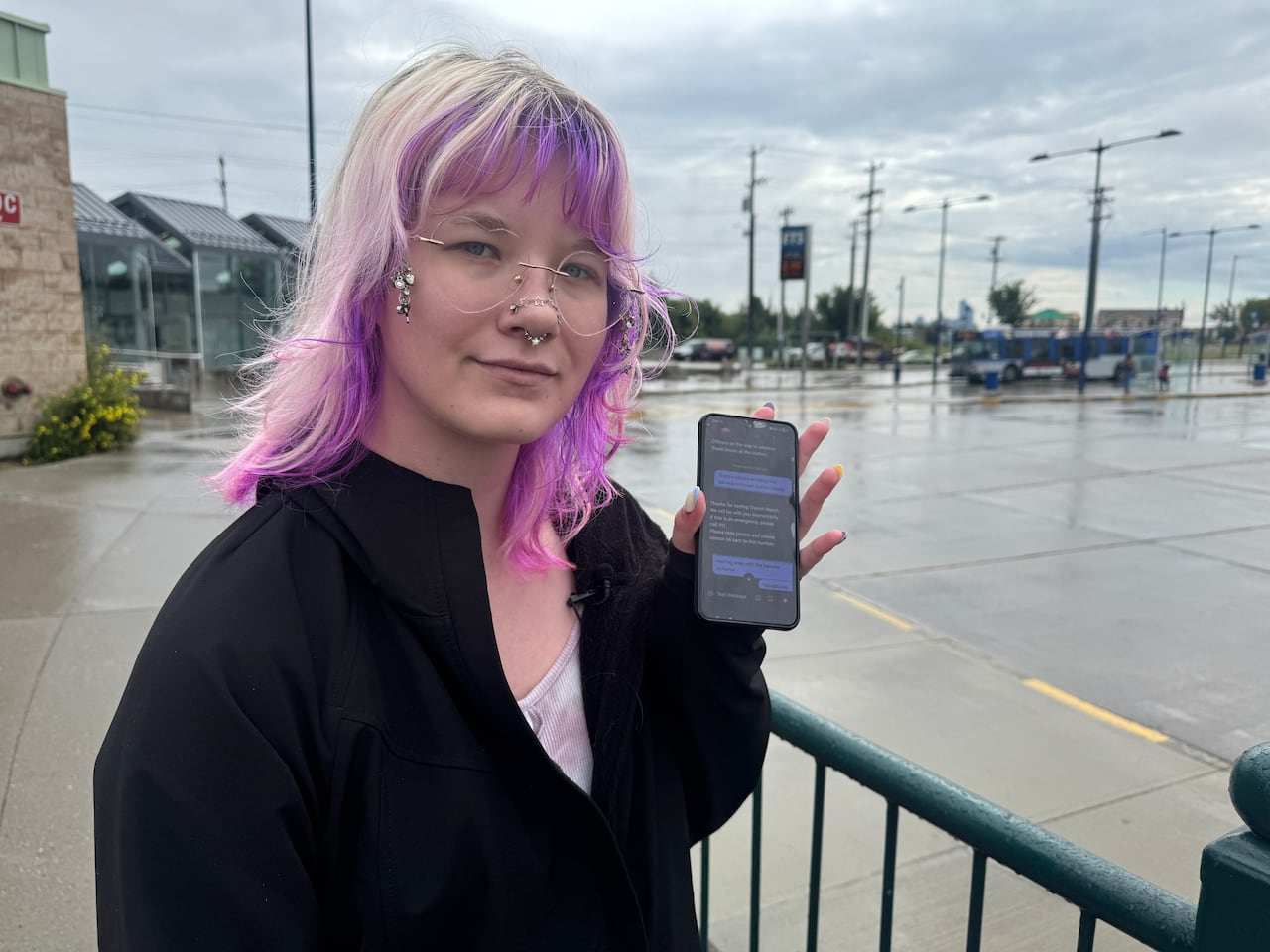
Rider Katarina Hamilton texts Transit Watch about once a month. (Madeleine Cummings/CBC)
Regular transit user Katarina Hamilton mentioned that she texts Transit Watch approximately once a month and frequently observes people blocking entrances and starting fires, particularly between 8 p.m. and 7 a.m.
About a year ago, she witnessed a weapon-involved fight at Central Station.
Concerned for her safety and that of nearby children, she sent a message to Transit Watch and subsequently contacted the police.
“That’s just not a safe situation to be in,” she remarked.
Hamilton stated that an increased presence of peace officers in the system and more security cameras on buses would enhance her sense of safety while using transit.
Perceptions of safety remain unchanged
ETS conducts annual surveys of thousands of riders to gauge their feelings about safety. In 2025, the percentage of transit users who felt secure during their last journey was 61 percent, a figure that has not changed compared to the previous year.
In a statement, Carrie Hotton-MacDonald, the branch manager of ETS, noted that riders’ safety perceptions are influenced by various factors, making it challenging to alter perceptions quickly.
She mentioned that more individuals reach out to Transit Watch during the colder months and that the number of texts received has grown annually, along with ridership and awareness about the safety line.
Data from the Edmonton Police Service indicates that police responses to violent incidents at LRT and transit center locations rose from 292 in 2024 to 307 in 2025.
So far this year, calls have been lower than those in 2025.
What could enhance safety?
Hotton-MacDonald stated that ETS is working on multiple initiatives to help riders feel more secure while using transit, including the addition of 30 peace officers and an eighth community outreach team.
“Other initiatives being introduced this year that may boost perceptions of transit safety include enhancing cellular connectivity in LRT tunnels, performing more rider outreach and engagement, providing travel training support to riders, and making infrastructural improvements at stations,” she said in the statement.
Ward O’Day-Min Councillor Anne Stevenson emphasized that transit safety has been a significant priority for the city council.
Pop-up events organized by the Edmonton Arts Council are contributing to a more vibrant atmosphere in downtown LRT stations, she stated, and she expressed her desire to support other initiatives, such as safety attendants.
She acknowledged ongoing challenges due to unaddressed root causes of social disorder.
“I am encouraged by the recent provincial announcement of an additional $30 million for housing and drug treatment support,” she remarked.
In a conversation about overdoses with CBC News last month, Councillor Jon Morgan expressed the belief that individuals lacking access to housing or addiction treatment often choose to use drugs on public transit for their own safety.
“They seek locations where they can consume drugs while being visible in case they experience drug-related emergencies,” he stated.
David Cooper, principal of Leading Mobility Consulting, a firm specializing in transit and transportation planning, noted that cities across North America are facing similar challenges and are seeking effective solutions.
Cooper co-authored a study on public transit drug use released last year and compiled a list of safety recommendations for Canadian transit authorities in 2023.
He acknowledged that cities like Edmonton have implemented many of his suggested measures, such as increasing enforcement and outreach personnel, enhancing cleaning efforts, and making design modifications to transit stations to deter crime.
“The ongoing challenge across the country is how to engage our partners at the provincial and federal levels to contribute more to this issue,” he remarked during an interview with CBC News.
He emphasized that while one-time funding announcements for staffing or infrastructure improvements are beneficial, cities require consistent support.
“It feels like we are pushing a boulder uphill right now, and if we let go, it will roll back down,” he concluded.
Tag: rewrite-pending