
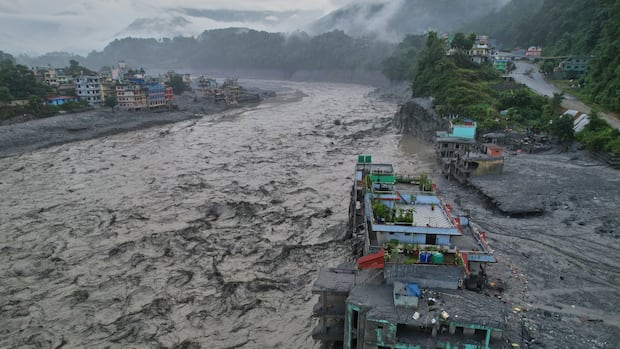

Authorities in Nepal have issued a warning about potential new flooding, urging residents in affected areas to stay vigilant as the Bhotekoshi River’s water levels have risen. Flood alerts were sent out to mobile phones on Sunday while rescue teams worked to clear a vital highway linking Kathmandu to a severely impacted region after the devastating floods on Wednesday resulted in at least 800 fatalities and over 3,000 people missing in Nepal and Tibet.
Following increased water flow information from Chinese authorities, Nepal’s National Disaster Risk Reduction and Management Authority’s CEO, Dharam Raj Uprety, relayed that fresh warnings were issued. Reports from China’s Ministry of Water Resources via Xinhua indicated that a newly formed lake post-flood had mostly drained, but a crater upstream holding 1.4 million cubic meters of water posed a risk and required monitoring.
The death toll in Nepal has risen to 788 with 2,502 missing, while Chinese officials reported 16 deaths and 546 missing on their side of the border. Among the missing individuals are numerous foreigners, including over 100 Nepalis and others from various nations. Rescue operations are ongoing at several hydroelectric projects, including the Upper Trishuli complex, where efforts are focused on a tunnel believed to have around 350 trapped individuals.
In Dhading, one of the worst-hit regions, residents are returning to assess the damage to their homes. Meanwhile, at a severely affected power plant serving thousands, inspections are underway to evaluate the extent of the destruction. The Prithivi Highway, a critical supply route, is facing repair challenges in some sections despite being mostly operational.
The flash floods, triggered by a glacial collapse in the Himalayas, led to extreme rockfall and water surges downstream in Tibet and Nepal. Nepal’s foreign affairs minister highlighted the urgent need for global action on climate change, stressing that despite minimal global emissions, Nepal is disproportionately impacted. Scientists have cautioned that as the Earth warms due to human activities, disasters like these may become more frequent, especially in rapidly warming regions like the Himalayas.