
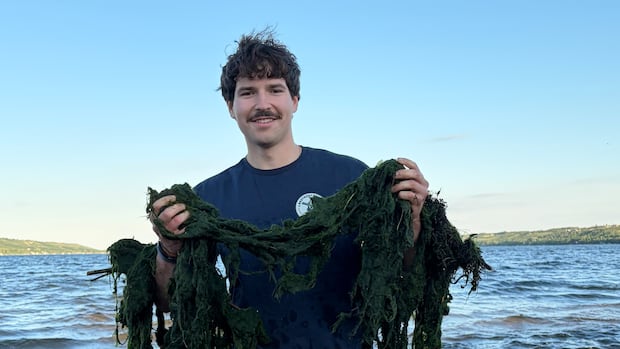

During the summer months, algae blooms are common in Saskatchewan lakes, presenting an opportunity for Denhyn Holowatuk to explore their potential as a biofuel source. Having recently completed a diploma in agriculture and food production at Saskatchewan Polytechnic, Holowatuk is experimenting with collecting algae from lakes in southern Saskatchewan and testing a method to convert it into ethanol, a sustainable fuel.
By utilizing a fermentation process involving seaweed, sugar, and vinegar, Holowatuk aims to produce alcohol that can be further extracted into biofuel. His interest in algae dates back to his childhood when he started collecting it from lake shorelines for his family. Over time, he expanded this activity into a small summer business serving lake-goers and property owners.
As part of his capstone project at Sask. Polytech, Holowatuk initially explored using algae for organic fertilizers. However, upon collaboration with Graeme Drysdale, research chair for sustainable energy solutions at the institution, the focus shifted towards investigating algae as a fuel source. Drysdale recognized the potential cost-saving benefits of utilizing collected algae for fuel production.
Drysdale’s engagement at the Hannover Messe industrial trade fair in Germany led to discussions with experts who had previously deemed algae biofuels economically unfeasible. However, ongoing research and advancements, such as the development of energy-efficient jet mixers, indicate a promising future for algae-based alternative fuels.
In a parallel initiative in Mexico, engineer Miguel Ángel Aké Madera’s project ‘Nopalimex’ is successfully converting sargassum seaweed into biofuel on a large scale. Inspired by such endeavors, Holowatuk’s project aims to evaluate the sustainability and economic viability of algae-based biofuel production in the long term.
Despite facing challenges in algae collection capacity, Holowatuk remains optimistic and plans to enhance the process with advanced equipment. He emphasizes the importance of raising awareness among lake-goers about ongoing efforts to repurpose algae, seeking a lasting solution for its utilization.