
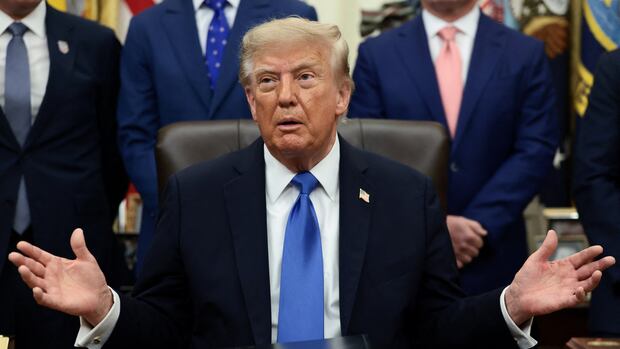

U.S. President Donald Trump suggested that the Bank of Canada operates as a commercial bank with branches in the United States, rather than being recognized as a Crown corporation solely based in Canada. Trump made these remarks during a meeting with travel industry leaders in the Oval Office, reiterating his reasoning for imposing tariffs on Canada, claiming that the country exploits economic advantages over the U.S.
He stated to reporters that American banks face restrictions in Canada, citing the example of Bank of America not being permitted to operate there. Trump expressed his view that Canada’s banking system reflects how they treat the United States unfavorably. Contrary to his statements, the Bank of Canada is a Crown corporation responsible for overseeing banking services for the Canadian government. Additionally, numerous U.S. financial institutions have established operations in Canada as foreign-owned banks with Canadian subsidiaries.
The Bank of Canada does not function as a standard commercial bank for the general public for account opening or transactions and does not operate within the United States. It primarily handles banking services on behalf of the federal government and plays a role in setting interest rates. Recently, the Bank maintained its benchmark interest rate at 2.25 per cent while highlighting concerns about rising inflation.
Despite Trump’s claims that U.S. banks are not allowed to operate in Canada, multiple American financial institutions are currently active in the Canadian market. These banks are categorized as Schedule 2 entities, representing foreign-owned banks with Canadian subsidiaries. Examples include JPMorganChase and Citibank, which have a long-standing presence in Canada. The competitive landscape in Canada’s banking industry, dominated by the Big Six domestic banks, presents challenges for foreign banks seeking to enter the market due to regulatory standards and market competition restrictions.